From the outside, it is a regular house in a congested south Delhi neighbourhood. But as I enter the premises of the Asian Heritage Foundation (AHF) to have lunch with India's culture czar Rajeev Sethi, it's as if I've stepped into another world. When I'd asked where he'd like to have lunch, Sethi had warmly extended an invitation to share the daily 'langar' (lunch) at AHF. I'm glad I assented. The sound of traffic fades, and is replaced by the soulful singing of saffron-clad bauls (folk singers from Bengal) in the courtyard. Artifacts, statuary, young interns and plants dot my path as I make my way to his office, where books of all sorts adorn the groaning bookshelves from floor to ceiling. Sethi breezes in, his shock of photogenic white hair instantly recognisable. I tell him that I've long wanted to meet with the man who has been responsible for introducing Indian culture to the West. "Why do you want to talk to me?" he asks. "I'm old hat and ready to retire." He refers to his vast collection of books, craft objects and artifacts as 'excess baggage', but as we chat, it becomes evident that much of AHF's energy comes from Sethi's ageless vision.
I can see that Sethi and his team are working round the clock for the Sasian Journey, an international festival he has conceptualised to celebrate South Asian culture and cuisine, which was held in Delhi at the end of March. A joint venture between the Smithsonian, the Asian Heritage Foundation, Self Employed Women's Association and other not-for-profit organisations from the nine participating south Asian countries, this is probably one of Sethi's most ambitious projects, one he says is closest to his heart. "I've always had a nagging, niggling feeling that conflicts that can't be solved politically, need to be addressed culturally," he says. South Asia is a cohesive cultural whole, and this is what he tries to showcase through the Sasian Journey. "Historically, our borders used to be very porous, but over the years, politics has relegated our shared history and geography to the background."
Given that Sethi engineered two spectacular Festivals of India as well as many other international expositions, his insights into what he refers to as India's creative and cultural industry are interesting. "I abhor the term 'craft'," he says, "It seems to establish a hierarchy between 'art' and 'craft', whereas I firmly believe that there are no hierarchies in creativity." Meanwhile, tantalising aromas waft from the kitchen where our lunch is being prepared. "Let me show you around before we sit for lunch," says Sethi. He shows me Jiyo, his pet project that has enabled skilled but economically vulnerable communities of India to make, what he terms 'cultural livelihoods'. "By providing design inputs to artisan communities, Jiyo is our effort to create a truly swadeshi Indian brand that makes traditional skills relevant in the modern global context," he says. There are contemporary wallpaper tiles made by Madhubani artists, lamps made by the shadow puppet makers of Andhra Pradesh, and, of course, the beautifully packaged Jiyo pickles.
"Our skilled communities are India's most important cultural and creative resource," says Sethi. "Until we empower them and recognise their vast repositories of traditional knowledge, the government's 'Make in India' campaign will not succeed." The way forward, he believes, is to link such businesses with the digital marketplace. "But the government must always support them as the market can be rather unforgiving," he avers. As we make our way back into the covered courtyard where lunch has been served, I muse that Sethi's brand of socialism has several merits, even though it perhaps ensures creative entrepreneurships like Jiyo remain avant-garde instead of mainstream.
An eclectic group of people has already gathered at the dining table when we reach. Pushpesh Pant, a noted food historian, is expounding upon the need to map south Asia's shared 'culinary geography' as he discusses how he's going to curate the Sasian Journey's food festival. The bauls are sitting there as well, strangely tongue-tied when they're not singing. The staff is there as well, and the conversation centres, unsurprisingly, on the festival. The food - lobia dal, mixed vegetables, paneer and salad - is wholesomely home-cooked. Sethi eats sparingly, but is a solicitous host, insisting on serving me personally. As we eat, he tells me how the AHF runs on funds derived from the select design interventions he takes up. The one that's made the biggest ripples, of course, is the new Terminal 2 at the Mumbai International Airport. "Instead of keeping art in museums, I wanted to create a space where it could be freely accessed by all. We've incorporated art from across the country in a single wall stretching over 1.2 kilometres... It's wonderful!" he says. He shows me a book he's created on another private project - a home of a prominent Gujarati industrialist. "This has paid for not just today's, but the last two year's langars here," he laughs.
Lunch over, I sit back and listen to the lively conversation around me, musing that Sethi has come a long way indeed from the time he designed Delhi's first discotheque, Cellar. "Oh, that was a lifetime ago," he says airily. I ask him what he plans to do after the Sasian Journey. "I need to retire, of course! I want to just be a mentor now."
I leave, taking a final look at the shady courtyard of curiosities, hoping he decides to stay on a little longer. For not many people have been as successful as Rajeev Sethi has been in showing the world (and in doing so, ourselves as well), all that is beautiful about India.

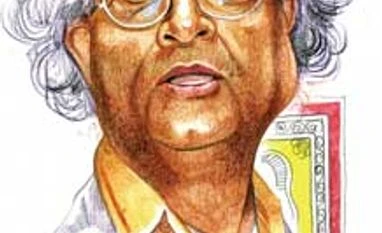 "<b>Lunch with BS:</b> Rajeev Sethi")


 Connect with us on WhatsApp