Poll positions

The election schedule reflects India's problem areas
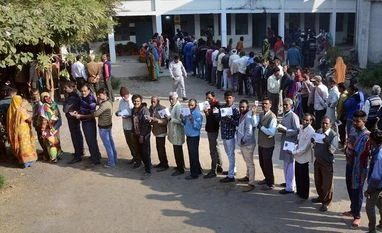
People wait with their identity cards to cast their votes for the Madhya Pradesh assembly elections. Photo: PTI
Business Standard Editorial Comment
4 min read Last Updated : Mar 12 2019 | 12:57 AM IST
Lasting over 39 days and covering seven phases between April 11 and May 19, the elections to the 17th Lok Sabha and four Assemblies mark the longest since electronic voting machines (EVMs) were introduced in 1999. This is also the longest duration since newly independent India’s first polls in 1951-52, which lasted four months, from October 25 to February 21. The obvious question is why this critical democratic process should take quite so long when India has in the past managed general elections in a much shorter time frame, that too using cumbersome ballot papers. Part of the answer, of course, is that the size of the electorate has expanded enormously, in keeping with India’s consistent record as the world’s largest democracy. 

The electorate was 173 million in 1951; the 2019 exercise is expected to involve a staggering 900 million voters. Assuming a similar 66-odd per cent turnout as in the 2014 polls, this implies that some 594 million voters — more than the population of the world’s most powerful democracy, the United States — will trudge to some one million polling booths in 543 constituencies from Kashmir to the Andaman and Nicobar Islands to elect India’s next government. This imposes far higher challenges on the Election Commission in terms of providing adequate poll infrastructure and security arrangements. The long process could have been reduced but for the average seven-day gap between each phase of elections. This leads to the unnecessary headache of deploying officials to guard the strong rooms where the EVMs will be kept.  

The poll schedule also offers an interesting snapshot of at least one aspect of governance in India, or the lack of it. It is easy to see why Uttar Pradesh, with 80 seats — the highest number in the Lok Sabha and spread over 240,000 square km — should entail seven phases of elections. But the timetable for some other states appears unusual. For instance, Maharashtra, with 48 seats, over 300,000 square km, will see four phases. Yet the polls in West Bengal, with 42 seats and covering 88,000-odd square km, will be conducted in seven phases. The same goes for Bihar, with 40 seats and covering roughly 94,000 square km. Jharkhand, with 14 seats and covering 79,000 square km, will also require four phases as will Madhya Pradesh (29 seats, over 300,000 square km) and Odisha (21 seats, over 150,000 square km). In sharp contrast, Tamil Nadu with 39 seats and covering 130,000 square km, Andhra Pradesh with 25 seats (over 160,000 square km), and Telangana (17 seats; over 112,000 square km) will have a single-phase poll.

The answer to such asymmetries lies, of course, in the law and order issues in these states. West Bengal and Bihar have well established reputations for regularly surpassing their own records as far as political violence is concerned. The extraordinarily brutal murders of Bharatiya Janata Party workers in West Bengal in 2018 suggest that the 2019 elections in that state, where communal tensions have been fuelled by both main contending parties, will be anything but peaceful. In Jharkhand, Madhya Pradesh and Odisha, Maoist unrest, which neither successive state nor the central governments have found a viable way to address, raises unique security challenges for the Election Commission, aptly captured in part by the 2017 hit movie, Newton. The same issue, considerably magnified of course, assails Jammu & Kashmir, which will have the piquant situation of having five electoral phases (between April 6 and May 6) for its six Lok Sabha seats. Law and order, thus, clearly explains why India needs such a long-drawn electoral process.

One subscription. Two world-class reads.

Already subscribed? Log in

Subscribe to read the full story →
*Subscribe to Business Standard digital and get complimentary access to The New York Times

Smart Quarterly

₹900

3 Months

₹300/Month

SAVE 25%

Smart Essential

₹2,700

1 Year

₹225/Month

SAVE 46%
*Complimentary New York Times access for the 2nd year will be given after 12 months

Super Saver

₹3,900

2 Years

₹162/Month

Subscribe

Renews automatically, cancel anytime

Here’s what’s included in our digital subscription plans

Exclusive premium stories online

  • Over 30 premium stories daily, handpicked by our editors

Complimentary Access to The New York Times

  • News, Games, Cooking, Audio, Wirecutter & The Athletic

Business Standard Epaper

  • Digital replica of our daily newspaper — with options to read, save, and share

Curated Newsletters

  • Insights on markets, finance, politics, tech, and more delivered to your inbox

Market Analysis & Investment Insights

  • In-depth market analysis & insights with access to The Smart Investor

Archives

  • Repository of articles and publications dating back to 1997

Ad-free Reading

  • Uninterrupted reading experience with no advertisements

Seamless Access Across All Devices

  • Access Business Standard across devices — mobile, tablet, or PC, via web or app

Next Story



