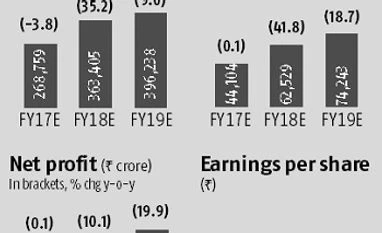
The mega capital expenditure that Reliance Industries Ltd (RIL) has incurred over the past few years is expected to yield results in 2017. The spotlight is on its telecom services venture, which has incurred a capex of $25 billion. But the current year will also witness payback on RIL's $15-billion investment in its core business of oil and gas as new capacities come on stream.
The process has already begun, with the commissioning of the first phase (50 per cent capacity) of its 2.2-million-tonne-per-annum paraxylene (PX) expansion project at the Jamnagar petrochemicals complex at an investment of $3-4 billion. While this commissioning is a key milestone, it is to be followed by the start of a refinery off-gas cracker, 3.3-million-tonne-per-annum capacity, by March.
After that, by mid-2017, a pet-coke regasification project should be coming on stream. Thus, the second half of 2017 will see some benefits after stabilisation of these projects. Third quarter of FY18 may be a stronger quarter for RIL. Analysts at CLSA say projects will lead to cash flow (or payback) after the end of Reliance's biggest capex binge.
The added PX capacity alone could push up RIL's petrochemical operating profit by $20 per million tonne per annum in FY18, estimate analysts at Religare Institutional Equities. Overall, an incremental operating profit of $2.5 billion from these projects is expected by analysts at CLSA. Hence, as benefits from investments in expansions in the core business start flowing in, profit will get a boost. Historically, the company has been a big performer after large capacities come on stream.
While core business expansions are positive and expected to provide a major boost, all eyes will be on telecom services venture Jio. The investments by RIL in the telecom venture since inception have been considered a drag on earnings and it is the success of Jio that will be a trigger for the stock. Analysts at CLSA say the stock is building a negative value for Jio, which indicates investor expectation of low subscriber retention after Jio becomes a paid service.
The rollout of services despite delays has been sentimentally positive, as Jio garnered 50-million subscriber base by November 2016 itself, leading to expectations the subscriber base will double by March 2017, when the free offer ends. The real test will come thereafter on retention of these customers. Analyst estimates now show positive retention expectations. While CLSA models an average customer base of 50 million, analysts at Religare say subscriber base of 60-75 million to start with in April 2017 could lead to a breakeven at the operating-profit level in FY18. Thus, expectations are increasing on the telecom venture becoming earnings-accretive. The June 2017 quarter performance of RIL will give a clear picture on growth from the telecom venture.
Meanwhile, the Street will focus on the December quarter performance. The benchmark Singapore complex gross refining margins (GRMs) have recovered sharply from $5.1 per barrel in Q2 to $6.7 per barrel in Q3. Reliance will see a modest recovery in GRMs to $10.8 per barrel, going by Jefferies estimates, due to a five-week maintenance shutdown in one of its units and sharper improvement in gasoline and fuel oil cracks relative to middle distillate cracks.
Also, maintenance shutdown and demonetisation are likely to lead to weaker petrochemical earnings sequentially. RIL stock closed flat at Rs 1,083 on Thursday.