Targeting tech

Chinese govt's recent steps can backfire
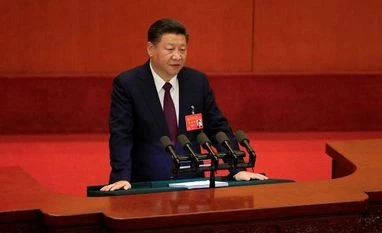
Chinese President Xi Jinping speaks during the opening of the 19th National Congress of the Communist Party of China at the Great Hall of the People in Beijing, China. Photo: Reuters.
Business Standard Editorial Comment Mumbai
3 min read Last Updated : Aug 03 2021 | 10:41 PM IST
China’s policymakers are intensifying the crackdown on the private sector and broadening its scope. The “anti-tech” policy has eroded the valuations of China’s tech giants and the education sector has been declared non-profit. Any business entity teaching school subjects cannot have foreign investors, list abroad, or make profits. This decree instantaneously eroded $600 billion of online education valuations. It is the latest in a sequence of moves against corporations. In November 2020, regulators blocked the $34-billion initial public offering (IPO) of fintech giant ANT. It was told to reform and restructure. ANT’s sister company, e-commerce giant Alibaba, was hit with a $2.8 billion fine for anti-competitive behaviour. Didi, which dominates China’s ride-hailing sector, came under fire just after its $4.4 billion IPO in the US. It is being investigated for data-collection practices and monopolistic behaviour. The Didi ride-hailing app was removed from super-apps, WeChat, and AliPay.

Further, Tencent, which runs WeChat, is under investigation for monopolist behaviour. It has been told it cannot keep exclusive copyright to its music portfolio. Regulators are also targeting e-commerce platforms like Taobao and Pinduoduo on various grounds. The food delivery service, Meituan, has been ordered to offer minimum wages and mandatory insurance to contracted delivery personnel. These actions have led the global investment community to review the risks of investing in China. There are hopes investors might look at India as an alternative destination but this may be over-optimistic in light of the textile experience — investors went to Vietnam and Bangladesh instead. India’s regulatory regime will need a comprehensive overhaul before it can compete with other emerging markets in terms of ease of doing business.
 
China-watchers have various explanations for the policy twist. One is that policymakers are perturbed with the increasing financial clout of corporate giants. China is also concerned the petabytes of data held by its corporate giants will be accessible overseas, if Chinese companies tap into global financing, and expand abroad. Of course, China may also be assuming that its internal resources, coupled with Hong Kong, will suffice if foreign investors pull out. But a third possibility, especially with respect to education, is that the Chinese Communist Party (CCP) is afraid of loosening its stranglehold on the hearts and minds of the next generation, if it allows private educators to freely introduce ideas or facts challenging the official narratives.

A fourth possibility is an anticipation that long-simmering trade disputes, coupled with aggressive “wolf warrior” diplomacy and territorial claims, can lead to a full-blown trade schism. The Trump administration imposed tariff barriers and barred Huawei from access to US markets and knowhow. If this escalates, Chinese companies listed abroad will be vulnerable, and hence, China may need to retool policy to focus on “hard” tech and basic science. History shows the Soviet model of government-directed research in “hard tech” does not work well. Around 80 per cent of research and development (R&D) investments come from China’s corporate sector. If corporations are starved of investments and denied the chance to make profits, there will be a decline in R&D. The reforms of the Deng Xiaoping-era propelled China towards becoming a middle-income country. There were 154 million outbound passengers in 2019. Chinese students who study abroad, businessmen, tourists, engineers working abroad — all have exposure to more open political systems. Shutting the cultural door, or rolling back the Deng reforms, may not be as easy.

One subscription. Two world-class reads.

Already subscribed? Log in

Subscribe to read the full story →
*Subscribe to Business Standard digital and get complimentary access to The New York Times

Smart Quarterly

₹900

3 Months

₹300/Month

SAVE 25%

Smart Essential

₹2,700

1 Year

₹225/Month

SAVE 46%
*Complimentary New York Times access for the 2nd year will be given after 12 months

Super Saver

₹3,900

2 Years

₹162/Month

Subscribe

Renews automatically, cancel anytime

Here’s what’s included in our digital subscription plans

Exclusive premium stories online

  • Over 30 premium stories daily, handpicked by our editors

Complimentary Access to The New York Times

  • News, Games, Cooking, Audio, Wirecutter & The Athletic

Business Standard Epaper

  • Digital replica of our daily newspaper — with options to read, save, and share

Curated Newsletters

  • Insights on markets, finance, politics, tech, and more delivered to your inbox

Market Analysis & Investment Insights

  • In-depth market analysis & insights with access to The Smart Investor

Archives

  • Repository of articles and publications dating back to 1997

Ad-free Reading

  • Uninterrupted reading experience with no advertisements

Seamless Access Across All Devices

  • Access Business Standard across devices — mobile, tablet, or PC, via web or app

Topics :ChinaBusiness Standard Editorial Commentchinese companies

Next Story



