The home office of lawyer, former Union minister and Bharatiya Janata Party (BJP) leader Arun Jaitley — who died on Saturday, August 24 — was the true testament to his personality.
Floor-to-ceiling bookshelves crammed with leather-bound compilations of court cases. In the midst of this intellectual splendour, two framed black and white pictures — of a young, intense-looking Jaitley, wearing thick glasses, standing beside former prime minister Morarji Desai, along with several other young men. These are from his days as a student leader.
There were no pictures of gods and goddesses in this office. Instead, there were framed replicas of legal certificates and mementos from various cricket associations, testifying to the other love of his life.
How did a man who clearly admired a political leader like Desai and was so fond of cricket that he named his son Rohan (like Sunil Gavaskar’s son) reconcile himself to the company of the rabble-rousing mob that brought down the Babri Masjid in 1992?
Others, too, were confused.
Arun Jaitley with former prime minister Atal Bihari Vajpayee in whose Cabinet he served. Photo: PTI
In a rediff.com chat session in the early 1990s, someone asked him: “Mr Jaitley, how can a so-called educated man like you be a member of an obscurantist, fascist organisation like the Bharatiya Janata Party (BJP)?”
He replied: “I reject your understanding of the BJP. Nehruvian thought, which regarded everything that was Indian, ethnic, traditional and cultural, as obscurantist and fundamentalist damaged the Indian ethos. We are criticised because it is said we are pro-Hindu. The threat to global secularism doesn’t come from either Indian nationalism or Hinduism, it comes from elsewhere — you know where. I think you and I need to re-discuss political definitions.”
With his death, Jaitley has taken with him a slice of the hearts of everyone who knew him; especially, his personal staff.
One of the highest tax payers in Delhi, Jaitley also got a block of flats built for the secretarial staff of his legal practice. The daughter of one of them is now a dentist, practicing in England; her education was funded by Jaitley.
Bureaucrats also found in him a reasonable boss, whose knowledge of business and law was astounding.
Jaitley enjoyed two things above all — a good meal and a good session of gossip.
Dal from Minar Restaurant at Connaught Place was among his favourite dishes. Jaitley once told this reporter how when he travelled to New York, he would have Indian dishes from a specific restaurant in Manhattan delivered to his hotel.
Bowling for the Supreme Court Bar Association team in 2005
His love for good gossip earned him many friends among journalists. But, as scribes are themselves notoriously gossipy, this trait also earned him enemies.
From Emergency to Parliament
Jaitley went to St Xavier’s, and chose science in school, believing he wanted to be an engineer. Later, he joined the bachelor of commerce course at Shri Ram College of Commerce of Delhi University.
It was during his college days that he learned to read a balance sheet — and plunged into politics. He had already become an activist of the Akhil Bharatiya Vidyarthi Parishad (ABVP), the youth wing of the Bharatiya Jana Sangh.
He had already contested the college union elections and the ABVP wanted him to stand for the Delhi University Students’ Union polls. But then, the Emergency happened.
“You are required to give legal opinion on a couple of cases,” he once said. “But 90 per cent of your time is spent meeting brief-less lawyers who want to be appointed state counsel.”
He was also the information and broadcasting minister briefly; he described the experience in a sentence: “It’s a ministry for Doordarshan that nobody watches anyway.” As commerce minister he did not have enough time to remove the Congress stamp.
Celebrating India’s victory over Pakistan in Karachi, in 2004, with Congress leader Priyanka Gandhi
It was the Ministry of Disinvestment that had really occupied him. He vowed to make a real change if the National Democratic Alliance ever came to power again, he said in 2004.
Jaitley was also a rock for Narendra Modi when the future PM decided to nudge BJP patriarch L K Advani out of the way and make a bid for the top job. He also drew up the blueprint to protect Modi from Delhi’s chattering classes. Modi also sought his advice on various matters — though not in all, such as the first Budget of his government presented.
In the electoral battle, Jaitley had missed success. But, in the Modi government, he was the mentor — he groomed half a dozen of those who became ministers. Some remembered, others did not — Jaitley seemed to care little. He concentrated on getting BJP re-elected, a target he achieved in his lifetime.

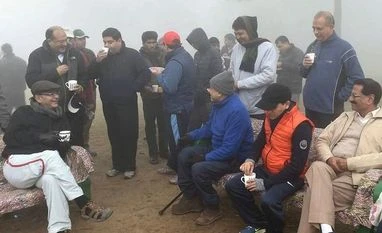 "Arun Jaitley: The Finance Minister who loved a good meal and good gossip")











