Austerity drive: No first-class travel, meets at five-stars, officials told
Also issued instructions for a mandatory 10% cut in non-Plan expenditure for all govt departments
BS Reporter New Delhi To cut its fiscal deficit to a seven-year low, the government has undertaken an austerity drive, with a ban on government officials travelling first-class on flights, as well as departments purchasing vehicles and holding meetings at five-star hotels. It has also barred the creation of new posts.
With the Centre's fiscal deficit at 74.9 per cent of the Budget estimate at the end of August, the finance ministry has also issued instructions for a mandatory 10 per cent cut in non-Plan expenditure for all government departments. This, however, doesn't include interest payment, repayment of debt, defence capital, salaries, pension, and Finance Commission grants to states, which account for a major chunk of non-Plan expenditure.
"Such measures are intended at promoting fiscal discipline, without restricting the operational efficiency of the government. In the context of the current fiscal situation, there is a need to continue to rationalise expenditure and optimise available resources," the ministry said in a memo.
Besides a ban on creation of Plan and non-Plan posts, the ministry said posts vacant for more than a year could only be revived under rare and unavoidable circumstances.
Asking officers to cut travel expenditure, it said video-conferencing facilities could be used effectively. In case of air travel, the lowest-fare tickets have to be purchased, while companions cannot travel for free. "While officers are entitled to various classes of air travel depending on seniority, utmost economy would have to be observed while exercising the choice, keeping the budget limitations in mind. However, there will be no bookings in first class," the ministry said.
While banning meetings and conferences at five-star hotels, it said holding events abroad would be strongly discouraged, except in the case of exhibitions for trade promotion.
Expenditure Secretary Ratan P Watal sought discipline in fiscal transfers to states, public sector undertakings and autonomous bodies of the central and state governments, as well as local bodies. To avoid wasteful expenditure, the ministry asked government departments and autonomous bodies to avoid bunching up spending in the last quarter. It reiterated its instructions of ensuring not more than 33 per cent of the Budget estimate was spent in the last quarter of a financial year and limiting expenditure in March to 15 per cent of the Budget estimate. It added no fresh financial commitments should be made on items that aren't provided for in the Budget approved by Parliament.
In Budget 2014-15, Finance Minister Arun Jaitley had retained the fiscal deficit target at 4.1 per cent of gross domestic product (GDP) set by his predecessor P Chidambaram (interim Budget 2014-15). For 2014-15, the government has proposed Plan expenditure of Rs 5.75 lakh crore and non-Plan expenditure of Rs 12.19 lakh crore.
The government aims to narrow its fiscal deficit to three per cent of GDP by 2016-17. After touching a high of 5.7 per cent in 2011-12, the deficit was cut to 4.8 per cent in 2012-13 and 4.5 per cent in 2013-14. The memo issued by the ministry on Thursday said secretaries would have to ensure compliance with the austerity measures, adding financial advisors would have to submit reports to the ministry on a quarterly basis.
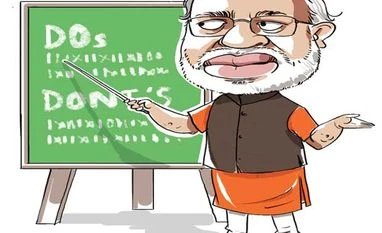
FRESH MANDATES - Mandatory 10% cut in non-Plan expenditure for every department
- Ban on meetings at five-star hotels; seminars abroad discouraged
- Ban on purchase of vehicles, including staff cars, to continue
- No first-class air travel or free companion tickets; lowest-fare tickets to be procured
- Ban on creation of Plan & non-Plan posts; posts vacant for more than a year not to be revived
- Discipline in fiscal transfers to states, PSUs, and autonomous bodies

 "Austerity drive: No first-class travel, meets at five-stars, officials told")


 Connect with us on WhatsApp