Burning of municipal waste discolouring Taj Mahal: Study
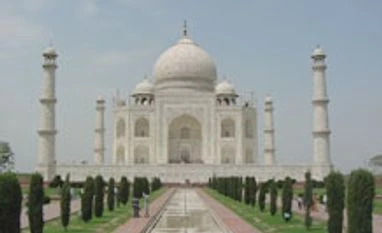
The Taj Mahal is a white marble mausoleum on the south bank of the Yamuna river in Agra
Press Trust of India Washington Burning of municipal solid waste in the vicinity of the iconic Taj Mahal is significantly contributing to the discolouring of the world heritage monument, an Indo-American research team has found.
The research compared the impact of dung cake burning versus the burning of municipal solid waste (MSW) on browning of Taj Mahal and on the health of people living nearby.
Using new field methods, researchers, including Ajay Nagpure from the University of Minnesota and Raj Lal of Georgia Institute of Technology in the US, provide scientific evidence that the burning of MSW in the vicinity of the monument could be contributing harmful levels of airborne particulate matter (PM).
The scientists found that open MSW burning leads to about 150 milligramme per square metre (mg m-2) per year of PM2.5 (fine particulate matter) being deposited on the surface of the Taj Mahal compared to about 12 mg m-2 per year from dung cake burning.
The researchers also highlight that these two sources combined represent a serious health concern based on estimates of premature mortality associated with PM2.5 exposure.
"Our early explorations find that just decreeing a blanket ban on MSW-burning is not effective as residents may have no other options," said Armistead Russell, from Georgia Institute of Technology.
"Instead, finding new ways to serve underserved and poor areas with waste pick up, potentially involving neighbourhood associations - appears to be a more promising route for authorities to pursue," said Russell.
The analysis involved characterising MSW burning and emissions in different neighbourhoods - wealthy, poor and middle-income - in multiple Indian cities.
Airborne particulate matter in cities poses a range of problems including degradation in air quality leading to health concerns and also the discolouration of ancient buildings, said researchers including Sachchida Tripathi from IIT-Kanpur and Anu Ramaswami from University of Minnesota.
In Agra, home to the Taj Mahal, authorities have taken a number of measures to curb the impact of local air pollution on the world heritage site, they wrote in the journal Environmental Research Letters.
These steps include restricting vehicles near the complex, requiring iron foundries to install scrubbers and filters on their smokestacks, prohibiting new polluting enterprises from being built within a defined buffer zone around the mausoleum, and - most recently - banning the burning of cow dung cake as cooking fuel, researchers said.
The Taj Mahal is a white marble mausoleum on the south bank of the Yamuna river in Agra. It was commissioned in 1632 by the Mughal emperor, Shah Jahan, to house the tomb of his wife Mumtaz Mahal.

 "Burning of municipal waste discolouring Taj Mahal: Study")


 Connect with us on WhatsApp