There are a lot of takers for the Aam Aadmi Party (AAP) headed by Arvind Kejriwal in India Inc, with some well-known names such as former Infosys Board member V Balakrishnan, former RBS India CEO Meera Sanyal and founder of Air Deccan G R Gopinath joining the party. Yet, many are unsure about the party’s economic policy.
Business Standard spoke to a number of chief executive officers (CEOs) across the country. The general refrain was: Happy with the party’s anti-corruption agenda but have worries about its economic policy.
“Its single biggest contribution has been the awareness it had created about corruption. They successfully managed to leverage public anger against corruption and the current set of politicians to its advantage,” says Harsh Mariwala, chairman and managing director (CMD), Marico.
The party’s strengths, according to most respondents, were its connect with the people, anti-VIP culture and austerity. But, its economic ideals and negative mindset are a worry, says Rajeev Talwar, executive director of Delhi-headquartered DLF.
The party, which was born out of an anti-corruption movement, is now running a government and the CEOs want it to make more “responsible” decisions.
Harsh Goenka, chairman of RPG Enterprises, says, “A nation can only progress if you pay the right price for one kg of rice or one unit of electricity. Freebies are not good for long-term economics.”
Goenka compared AAP’s success with that of the Trinamool Congress in West Bengal, where, he feels, the people might still vote for the party despite being unhappy with its governance record, as the voters were tired of the CPM’s 30-year misrule.
Mohandas Pai, chairman of Manipal Global Education, says, “The party was born out of its fight against corruption. So, India Inc is not quite sure who represents its economic policy or whether it even has one or not.”
Despite these apprehensions, most feel the party has managed to grab serious eyeballs and is likely to force traditional parties to focus more on pressing issues such as corruption, identity politics and transparency.
Ganesh Natarajan, vice-chairman and CEO, Zensar Technologies, says, “I think AAP is a breath of fresh air, and they are obviously making all the older parties wake up and take notice, which is good for the democracy.” And, as Harkirat Singh, MD, Woodland, puts it: “The middle class can relate to them.”
What seems to have worked for the party is its composition, which includes a cross section of people with no glaring regional or caste bias. “It is a party predominantly of the youth with no baggage; based on the anti-corruption plank,” says M S Unnikrishnan, MD & CEO, Thermax.
Some CEOs also feel that by committing to fighting the coming Lok Sabha elections, the party is spreading itself too thin, too soon. “My sense is that they are jumping the guns too early, in terms of trying to take up too many things. I think they must demonstrate that they can deliver in Delhi before trying to venture out and trying to do everything within a couple of months,” says Krishna Kumar Natarajan, co-founder, CEO & MD, Mindtree. “There is no steroid treatment to build an institution.”
Agrees Mariwala: “I am not sure whether forming the government in Delhi or deciding to contest 200-300 seats during the Lok Sabha elections was the right move. I find it a little too ambitious. They may at best act as spoilers to the key political parties (BJP and Congress) by winning 30 to 40 seats.”
While lack of clarity on policy issues is a worry, many say it is too soon to judge it as well. “These are still early days, but I think AAP will have to realise that it can only survive if the country makes real progress, and if the country has to progress, there has to be economic development. And economic development can only come by unleashing the power of both private and public enterprises,” adds Swaminathan Dandapani, executive chairman of Manipal Health Enterprises & Former CEO & MD of Infosys BPO.
Some feel that the party’s policies may not turn out to be all bad. “I think AAP is good for corporate India because it would make the system more transparent. At least, they are demanding transparency, accountability, and results which are great because with these whatever friction there is in running businesses will hopefully get removed,” adds Natarajan.

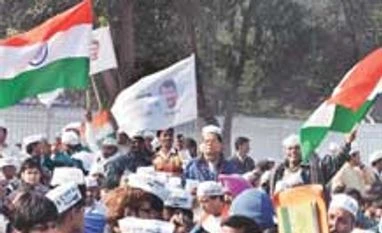 "India Inc happy with AAP's anti-graft plank but confused about its economic agenda")

