
Delhi air quality plunged to 'severe' in many parts this afternoon: SAFAR
At 12.30 pm, the city's overall air quality index was 390 -- marginally better than Monday's high of 397 at 8 pm, according to the Central Pollution Control Board
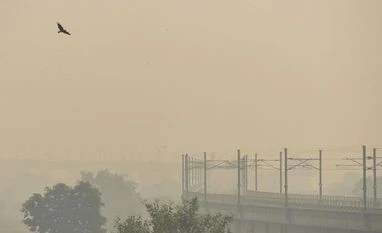 "Delhi air quality plunged to 'severe' in many parts this afternoon: SAFAR")
Explore Business Standard
At 12.30 pm, the city's overall air quality index was 390 -- marginally better than Monday's high of 397 at 8 pm, according to the Central Pollution Control Board
The skies over the national capital were a smoky grey on Tuesday as the sun struggled to shine through the haze with the air quality deteriorating and slipping into the "severe" category in several places in the city.
At 12.30 pm, the city's overall air quality index was 390 -- marginally better than Monday's high of 397 at 8 pm -- according to the Central Pollution Control Board.
Pollution levels in the satellite towns of Ghaziabad (429), Greater Noida (418), and Noida (427) were worse.
An AQI between 0-50 is considered good, 51-100 satisfactory, 101-200 moderate, 201-300 poor, 301-400 very poor, and 401-500 severe. Above 500 is severe-plus emergency category.
According to the Ministry of Earth Sciences' air quality monitor SAFAR, the levels of PM2.5 tiny particulate matter less than 2.5 microns that can enter deep into the lungs reached 740 in Delhi University, several hundred times higher than the 0-60 considered "good".
Other areas of the city were no better.
Anand Vihar was the most polluted area in the capital with an AQI of 436 and Nehru Nagar following with an AQI of 430.
Delhi's air quality took a hit after on Diwali night due to a combination of firecracker emissions, stubble burning and unfavourable meteorological conditions.
Since then, pollution levels have been oscillating between the lower end and the higher end of the very poor category.
On Diwali night, a large number of revellers brazenly flouted the Supreme Court-enforced two-hour limit for bursting crackers.
The Supreme Court had also ordered that only green firecrackers, which cause 30 per cent less pollution, can be manufactured and sold, but a DPCC official said a large number of illegal crackers were burst on Diwali.
The Arvind Kejriwal government had organised a mega laser show in an effort to dissuade people from bursting crackers.
SAFAR said an increase in the wind speed will help disperse pollutants and the pollution levels are expected to come down.
However, officials at the Indian Meteorological Department said a significant increase in the wind speed is unlikely over the next two days and similar conditions are expected to prevail.
The AQI takes into account five chief pollutants - particulate matter with a diameter less than 10 micrometres (PM10), PM2.5, ozone (O3), nitrogen dioxide (NO2), and carbon monoxide (CO).
The higher the AQI value, the greater the level of air pollution and the greater the health concern.
First Published: Oct 29 2019 | 3:35 PM IST

