Will return Rs 190 cr subsidy to original accounts: Airtel to NPCI
Airtel and its Payments bank came under fire after Airtel allegedly opened accounts of its mobile phone subscribers without seeking their 'informed consent'
Press Trust of India New Delhi Within days of getting a rap on its knuckles, Airtel on Monday offered to return Rs 190 crore subsidy that had flown into the 'unsolicited' Payments Bank accounts of its 3.1 million mobile phone subscribers, sources said today.
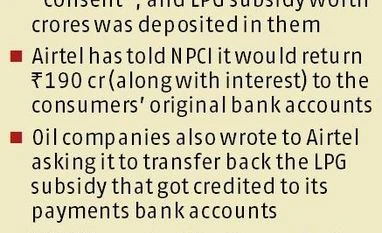
Airtel wrote to National Payments Corporation of India (NPCI) today promising to return Rs 190 crore (along with interest) to the consumers' original bank accounts that were linked to the Direct Benefit Transfer (DBT), the sources familiar with the development told PTI.
NPCI is an umbrella organisation for all retail payments in India.
Both Airtel and Airtel Payments bank came under fire after Airtel allegedly opened accounts of its mobile phone subscribers without seeking their "informed consent", and LPG subsidy worth crores was being deposited to these accounts.
The government acted swiftly in the matter and the Unique Identification Authority of India, late last week, temporarily barred the company from conducting Aadhaar-based SIM verification of mobile customers using eKYC process and e-KYC of payments bank clients.
Suspending the 'e-KYC licence key', the Aadhaar issuing body UIDAI also ordered PricewaterhouseCoopers to conduct an audit of Bharti Airtel and Airtel Payments Bank to ascertain if their systems and processes are in compliance with the Aadhaar Act.
"The government has taken a stern view of the entire issue and Airtel has been forced to return the amount to original bank account of these customers," said a government source who did not wish to be named.
The mechanism of the DBT benefits floating into the accounts is also being tightened, to bring in greater accountability, he noted.
Mounting pressure on Airtel, the state-run oil companies had begun writing to the billionaire Sunil Mittal-led firm asking it to transfer back the LPG subsidy that got credited to its payment bank accounts.
The subsidy that government pays to households for buying cooking gas LPG has got credited to these payments bank accounts, leading to inconvenience to users many of whom did not know that their entitlement was not coming to their regular bank account but going an account which they had not applied for.
Taking a lead, Hindustan Petroleum Corp Ltd (HPCL) wrote to Airtel asking it to revert the subsidy to the customers' earlier bank account or transfer them same to the oil companies.
In a statement earlier in the day, HPCL said oil marketing companies and the oil ministry has been getting a large number of complaints from LPG consumers on not receiving LPG subsidy amounts into their earlierbank accounts for the past few weeks.
"In many cases across the three oil marketing companies (Indian Oil Corp, Bharat Petroleum Corp Ltd and HPCL) where the Aadhaar linking of LPG consumers has got changed in the NPCI mapper to Airtel Payments Bank and hence the LPG subsidy is getting sent to the new bank account in the Airtel Payments Bank," it had said.
In order to check diversions, the government pays subsidy equivalent to buying 12 LPG cylinders of 14.2-kg each in a year, directly into the bank accounts of beneficiaries.
Unlike in the past, LPG now is only available at market price. Beneficiaries get subsidy for one cylinder in advance and are replenished the moment they use it up to buying LPG refill.
A detailed email sent to Bharti Airtel on Sunday (December 17) on the the impact of UIDAI's latest move on the SIM verification process, and the alternate mechanism being worked out by the company, remained unanswered.

 "Will return Rs 190 cr subsidy to original accounts: Airtel to NPCI")


 Connect with us on WhatsApp