AIDS claimed a million lives in 2016, almost half the 2005 toll that marked the peak of the deadly epidemic, said a UN report today proclaiming "the scales have tipped".
Not only are new HIV infections and deaths declining, but more people than ever are on life-saving treatment, according to data published ahead of an AIDS science conference opening in Paris on Sunday.
"In 2016, 19.5 million of the 36.7 million people living with HIV had access to treatment," said the UNAIDS global roundup.
This marked the first time that more than half of infected people were receiving anti-retroviral treatment, which subdues the AIDS virus but does not kill it.
"AIDS-related deaths have fallen from 1.9 million in 2005 to one million in 2016," said the authors, adding that "for the first time the scales have tipped."
The year 2016 saw 1.8 million new infections, almost half the record number of some 3.5 million in 1997, said the report.
In total, 76.1 million people have been infected with HIV, the virus that causes AIDS, since the epidemic started in the 1980s. Some 35 million have died.
"Communities and families are thriving as AIDS is being pushed back," said UNAIDS executive director Michel Sidibe.
"As we bring the epidemic under control, health outcomes are improving and nations are becoming stronger."
As yet, there is no HIV vaccine or cure, and infected people rely on lifelong anti-retroviral therapy to stop the virus replicating.
Without treatment, HIV-infected people go on to develop AIDS, a syndrome that weakens the immune system and leaves the body exposed to opportunistic infections such as tuberculosis, and some types of cancer.
Treatment carries side effects and is costly, but allows infected people to be healthier for longer.
Most progress has been made in east and southern Africa, the region that was hardest hit by the epidemic and where many interventions were focused.
Since 2010, AIDS-related deaths in the region declined by 42 per cent. The region accounts for half the world's infected population, with women and girls disproportionately affected at 60 per cent.
Sixty per cent of all people who receive anti-retroviral therapy live in east and southern Africa which, along with west and central Europe and the Americas, is on target to meet the so-called 90-90-90 targets set by the UN, said the report.
By 2020, states the plan, 90 percent of infected people must know their status, of whom 90 percent must be on treatment. In 90 per cent of those, the virus will be "suppressed" by medicine to the extent that it cannot function or replicate.
By 2016, 70 per cent of infected people knew their status, said the new report. Of those, 77 per cent were on treatment, and 82 per cent had virus suppression.
UNAIDS expressed concern about two regions with worsening AIDS trends: the Middle East-North Africa, and eastern Europe-central Asia. Both are areas marred by conflict and political uncertainty.
(Only the headline and picture of this report may have been reworked by the Business Standard staff; the rest of the content is auto-generated from a syndicated feed.)

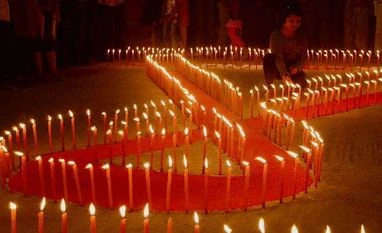 "AIDS toll halved since 2006, but still claimed 1 mn lives last year: UN")


 Connect with us on WhatsApp