
'Judges appointing judges' a propagated myth, says CJI Ramana
There is a need to liberate the institution of public prosecutors. Total independence must be granted to them and to make them answerable only to the Courts, he further said
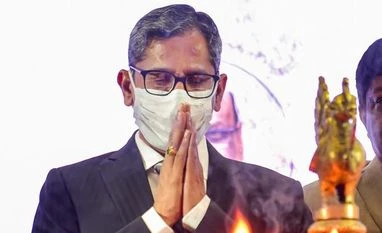 "'Judges appointing judges' a propagated myth, says CJI Ramana")
WebinarsNew
Deep DiveNew
Explore Business Standard
There is a need to liberate the institution of public prosecutors. Total independence must be granted to them and to make them answerable only to the Courts, he further said
The notion that "judges are themselves appointing judges" is a myth as the judiciary is just one of the many players involved in the process of selecting judicial officers, Chief Justice of India N V Ramana said on Sunday.
He was delivering the fifth Sri Lavu Venkatewarlu Endowment Lecture on "Indian Judiciary - Challenges of future" at Siddhartha Law College, Vijayawada.
He also said that in recent times, physical attacks on judicial officers are on the rise and at times, there are concerted campaigns in the print and social media against judges if parties do not get a favourable order while these attacks appear to be "sponsored and synchronised."
There is a need to liberate the institution of public prosecutors. Total independence must be granted to them and to make them answerable only to the Courts, he further said.
"It is nowadays fashionable to reiterate phrases such as 'judges are themselves appointing judges'. I consider this to be one of the widely propagated myths. The fact is the Judiciary is merely one of the many players involved in the process," Justice Ramana said.
Recently, Kerala MP John Brittas had reportedly said during a debate in Parliament on The High Court and Supreme Court Judges (Salaries and Conditions of Service) Amendment Bill, 2021 that Judges appointing judges is unheard of anywhere.
"Many authorities are involved, including the Union Law Ministry, State Governments, Governor, High Court Collegia, Intelligence Bureau, and lastly, the topmost executive, who all are designated to examine the suitability of a candidate. I am sad to note that the well-informed also propagate the aforesaid notion. After all, this narrative suits certain sections, Justice Ramana said.
Appreciating the Centre for its efforts on appointing more judges, he said, some recommendations made by High Courts are yet to be transmitted to the Supreme Court by the Union Law Ministry. It is expected that the Government needs to strictly adhere to the timelines laid down in the Malik Mazhar Case.
The law enforcing agencies, particularly the specialised agencies, need to deal with malicious attacks on judiciary effectively, the CJI said, adding that it was unfortunate that unless the Court interfered and passed orders, the authorities generally do not proceed with the investigation.
"The Governments are expected and duty bound to create a secure environment so that the judges and judicial officers can function fearlessly," he said.
New media tools have enormous amplifying ability, but appear to be incapable of distinguishing between right and wrong, good and bad and the real and fake. Media trials cannot be a guiding factor in deciding cases, he further said.
He said historically, prosecutors in India have been under the control of the government.
"Hence it is not a surprise that they do not act independently. They do nothing to prevent frivolous and non-deserving cases from reaching the courts. Public Prosecutors automatically oppose bail applications without independently applying their mind. They attempt to suppress evidence during trial which could benefit the accused," Justice Ramana said.
A holistic rework needs to be undertaken. In order to insulate the Public Prosecutors, an independent selection committee may be constituted for their appointment. Best practices should be adopted after a comparative analysis of other jurisdictions, he opined.
While making legislations, the law makers must also think of providing effective remedies for issues which may arise out of the law and yet these principles seemingly are being ignored, he opined.
Citing the Bihar Prohibition Act in 2016 which resulted in the High Court being filled with a lot of bail applications, Justice Ramana said lack of foresight in legislating can directly result in the blockage of courts.
(Only the headline and picture of this report may have been reworked by the Business Standard staff; the rest of the content is auto-generated from a syndicated feed.)
First Published: Dec 26 2021 | 12:35 PM IST


 Connect with us on WhatsApp