
Urge Pak to take sustained, irreversible action against terror groups: US
We believe in the potential of the US-Pakistan relationship to foster regional stability and economic prosperity, senior state department official, Alice G Wells said
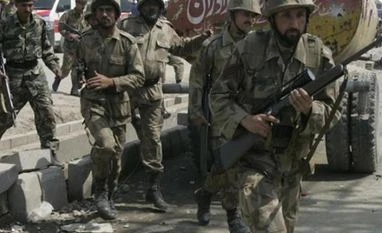 "Urge Pak to take sustained, irreversible action against terror groups: US")
WebinarsNew
Deep DiveNew
Explore Business Standard
We believe in the potential of the US-Pakistan relationship to foster regional stability and economic prosperity, senior state department official, Alice G Wells said
Pakistan has taken some "important" steps against terror groups post Pulwama attack but they are still reversible, a top US official said Wednesday, urging the Pakistani leadership to take sustained actions against terrorists operating in the country.
Terrorist organisations such as Lashkar-e-Taiba (LeT) and Jaish-e-Muhammad (JeM) will continue to pose a grave risk to international peace as long as they are able to operate freely in Pakistan, Alice G Wells, senior state department official for South and Central Asian Affairs told House Foreign Affairs Subcommittee for Asia, the Pacific and Nonproliferation.
"On the broader issue of counter-terrorism, the Pulwama terrorist attack in February that sparked a crisis between India and Pakistan underscored the importance and immediate need to halt terrorist activity in the region," she said in a prepared statement.
The sub-committee of the House Foreign Affairs Committee is scheduled to hold a hearing US Interests in South Asia and the FY 2020 Budget on Thursday.
"We continue to urge Pakistan's leaders to make good on their pledges to take sustained and irreversible actions against terrorist groups operating within the country's borders, which is necessary for the long-term stability and prosperity of the region, she said.
In recent months, we have seen Pakistan detain some militants and seize assets belonging to front organisations raising funds for terrorist groups. While these steps are important, they are still reversible, she told the lawmakers.
She asserting that Pakistan must sustain these measures and expand upon them, including by prosecuting terrorist leaders.
On a multilateral level, we succeeded on May 1 in listing JeM leader Masood Azhar at the UN 1267 Sanctions Committee an achievement 10 years in the making. His listing sends an important message that the international community will not tolerate terrorism, she said.
Wells said that US relationship with Pakistan remains one of its most complex and most consequential.
In line with the Trump administration's South Asia strategy, its approach to Pakistan has focused largely on securing Islamabad's support for the Afghan peace process and for Pakistan to follow through on its pledges to take sustained and irreversible actions against all militant groups operating from within its territory, she said.
Our engagement with Pakistan on nonproliferation issues is also crucial. The US and Pakistan both attach high importance to preventing the proliferation of weapons of mass destruction. We remain concerned, however, about Pakistan's development of certain categories of nuclear weapons and delivery systems, Wells said.
On Afghanistan reconciliation, she said, "We recognise that Pakistan has taken steps to encourage Taliban participation in peace negotiations, which has been important to the progress we have made thus far."
However, there is much more work to be done to achieve our ultimate goal of a peaceful Afghanistan free of terrorist groups, she said.
Pakistani officials are correct when they say that no other country will benefit more from a peaceful Afghanistan than Pakistan, and we expect Pakistan to continue to play a constructive role in reconciliation efforts, she added.
Wells said that sustained progress on these two issues reconciliation and counterterrorism will lie at the heart of a renewed bilateral relationship.
We believe in the potential of the US-Pakistan relationship to foster regional stability and economic prosperity, she said.
In the next year's budget, she said the Trump administration will focus civilian assistance programming on priority areas such as building capacity to deter the proliferation of weapons of mass destruction; building law enforcement capacity to fight crime and terrorism; and supporting economic development that can expand US business ties with Pakistan.
It will also focus on addressing communicable diseases that threaten both the countries; supporting civil society and religious freedom; and working with Pakistan to ensure that communities in the Afghanistan-Pakistan border region are stable and cannot be used as a base by terrorists, she said.
"The request reflects the trajectory of our relationship away from an assistance focus and toward a more trade-based one, and the bright economic future we believe a more robust US-Pakistan partnership can bring for Pakistan and the region, should Pakistan follow through on its pledges to fight terrorism and promote peace in Afghanistan," Wells said.
First Published: Jun 13 2019 | 12:30 AM IST


 Connect with us on WhatsApp