US ready for military strike if diplomacy fails: Kerry
A military strike could change Assad's willingness to use the chemical weapons, he said
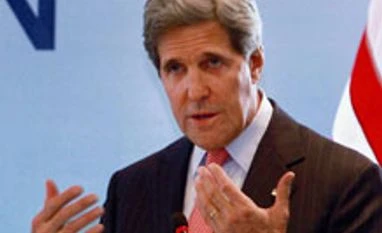
Press Trust of India Washington The United States would resort to military strike against the Assad regime if diplomacy fails to remove the chemical weapons of Syria, US Secretary of State John Kerry has said, as he initiated talks with Russia in Geneva in this regard.
"President (Barack) Obama has made clear that should diplomacy fail, force might be necessary to deter and degrade Assad's capacity to deliver these weapons.
"It won't get rid of them, but it could change his willingness to use them," Kerry told reporters yesterday, in Geneva at a joint press availability with his Russian counterpart, Sergei Lavrov, where the two delegation are holding talks on bringing the Syrian chemical weapons under international control.
"The best thing to do, we agree, is remove them altogether. Our challenge here in Geneva is to test the viability of placing Assad's chemical weapons under international control, removing them from Syria, and destroying them forever," Kerry said.
"But the United States has also made clear that the deaths of more than 100,000 Syrians and the displacement of millions either internally or as refugees remains a stain on the world's conscience. We all need to keep that in mind and deal with it," the US Secretary of State said.
Lavrov said that the resolution of the Syrian crisis through diplomatic means would make military strike unnecessary.
"We proceed from the fact that the solution on this problem will make unnecessary any strike on the Syrian Arab Republic, and I am convinced that our American colleagues, as President Obama stated, are firmly convinced that we should follow the peaceful way of resolution of the conflict in Syria," he said.
In Washington, the White House spokesperson, Jay Carney, reiterated that the military action is not off the table.
"The basic position, as the (US) President described in his address to the nation (on Tuesday), is that the military remains in a position to execute a plan around holding Assad accountable for his appalling use of chemical weapons against civilians.
And that remains true today," he said in response to a question at his daily news conference.
"We are obviously focused on pursuing this diplomatic option. I think that is the right thing to do. It is certainly the responsible thing to explore this avenue and to see if it is possible to resolve this peacefully, or diplomatically," he said.
The negotiations going on in Geneva with regard to Syrian chemical weapons, he said, would take time.
"I will simply say from here that this understandably will take some time," he said.

 "US ready for military strike if diplomacy fails: Kerry")


 Connect with us on WhatsApp