
Asian shares skid, crude tumbles after Doha deal fails
The pact fell apart after Saudi Arabia demanded that Iran join in
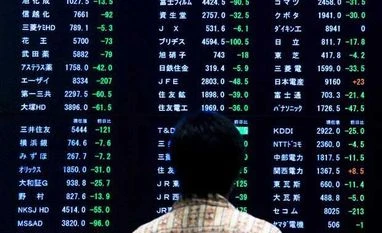 "Asian shares skid, crude tumbles after Doha deal fails")
Explore Business Standard
The pact fell apart after Saudi Arabia demanded that Iran join in
Tumbling crude oil futures knocked Asian shares on Monday after producers' talks failed to agree on a plan to curb the global supply glut, while Tokyo stocks skidded as investors assessed the impact of a devastating earthquake in southwestern Japan.
The gloom was expected to spread to European bourses, with financial spreadbetter IG predicting Britain's FTSE 100 would open 0.9% lower and Germany's DAX was seen opening down 0.8%.
Some 18 oil exporting nations, including OPEC members, had gathered in Doha, the capital of Qatar, over the weekend in an attempt to agree to stabilise output at January levels until October 2016. The pact fell apart after Saudi Arabia demanded that Iran join in.
Brent crude futures tumbled about 4.2% to $41.31, while US crude slid about 4.4% to $38.59.
MSCI's broadest index of Asia-Pacific shares outside Japan was 0.8% lower, pulling away from a five-month intraday high touched on Friday.
China's blue-chip CSI300 index was down 1.4%, while the Shanghai Composite Index lost 1.5%.
S&P 500 e-mini futures dropped 0.7%. Wall Street ended with modest losses on Friday but major indexes still posted weekly gains.
The Nikkei stock index ended down 3.4%, as investors and companies assessed the impact of devastating earthquakes in southwestern Japan's Kyushu island on manufacturers' supply chains.
A 7.3 magnitude tremor struck early on Saturday, following a smaller quake on Thursday, centred on the region's Kumamoto prefecture, an important manufacturing hub.
"We're seeing a perfect storm of the kind of negativity that feeds into people's fears and underscores the dangers lurking in a market where sentiment is very sensitive," said Stefan Worrall, director of Japan equity sales at Credit Suisse.
"It's unsurprising the yen's recent weakness has reversed given the sour macro sentiment arising from events like the natural disaster, the failure of the OPEC meeting to follow through on the encouraging promise it had shown, as well as smaller geopolitical risks like the impeachment going on in Brazil."
Brazilian President Dilma Rousseff lost a crucial impeachment vote in the lower house of Congress on Sunday and appeared almost certain to be forced from office. That could end 13 years of leftist Workers Party rule in Latin America's biggest economy.
Brazil's stocks and currency have been among the world's best-performing assets in recent weeks on growing bets that Rousseff would be removed from office, allowing her successor to adopt more market-friendly policies.
A Tokyo-listed exchange-traded fund of Brazilian equities was up 4.5%.
The plunge in crude oil prices took a large slice out of commodity currencies.
The greenback gained 1% against the Canadian dollar to C$1.2952 while the Australian dollar shed 0.8% to $0.7665.
The Japanese yen, a perceived safe-haven currency, got a lift from the turmoil, with the dollar skidding 0.7% to 107.96 yen.
Also bolstering the yen, Japan's lobbying efforts at last week's Group of 20 finance ministers' meeting in Washington failed to result in informal consent to act against an unwelcome currency rise. US officials appeared unconvinced by Japan's argument that the yen's recent gains have been too sharp.
The euro was down 0.7% against its Japanese counterpart at 121.83 yen after earlier dropping to 121.71, its lowest since April 2013.
The euro barely budged, edging up slightly to $1.1284, which helped the dollar index hold steady at 94.729.
US economic data out on Friday was eclipsed by subsequent events but still gave investors little reason to cheer. Industrial production dropped a more-than-expected 0.6% last month, its sixth dip in the last seven months, while consumer sentiment fell to its lowest since September.
Gold, another perceived safe-haven asset, also got a lift. Spot gold rose 0.2% to $1,235.51 an ounce.
First Published: Apr 18 2016 | 11:48 AM IST

