
China stocks fall again as Beijing stays on sidelines
Chinese stocks sank again on Tuesday, despite a rebound in markets elsewhere in Asia, as investors despaired at the lack of policy action
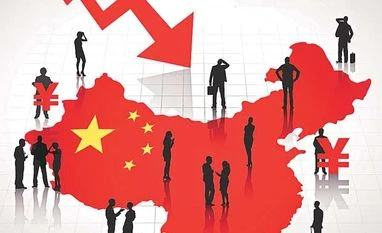 "China stocks fall again as Beijing stays on sidelines")
WebinarsNew
Deep DiveNew
Explore Business Standard
Chinese stocks sank again on Tuesday, despite a rebound in markets elsewhere in Asia, as investors despaired at the lack of policy action
Chinese stocks sank again on Tuesday, despite a rebound in markets elsewhere in Asia, as investors despaired at the lack of policy action from Beijing in response to recent data suggesting the downturn in the world's second-largest economy is deepening.
Major Chinese stock indexes tumbled more than 6% in early trading, hitting their lowest levels in 8 months, following their more than 8 percent plunge on Monday that sent shockwaves through global financial markets.
China, a key driver of the world economy, has overtaken Greece at the top of the worry list of global investors, who fret its economy is growing at a much slower pace than Beijing's 7% target for 2015.
"Global investors are cannibalising each other. Calling it a market disaster is not an overstatement," said Zhou Lin, an analyst at Huatai Securities.
"The mood of panic is dominating the market ... And I don't see any signs of meaningful government intervention."
The CSI300 index of the largest listed companies in Shanghai and Shenzhen finished the morning session down 3.9%, while the Shanghai Composite Index fell 4.3%.
After the turmoil in China rocked world equity and commodity markets on Monday, policymakers elsewhere in Asia sought to soothe fears about the broader impact on the global economy.
"I think it's important that people don't hyperventilate about these type of things," said Australian Prime Minister Tony Abbott, whose country is heavily exposed to China, the biggest consumer of its commodity exports.
"It is not unusual to see stock market corrections. It is not unusual to see bubbles burst in particular markets and for there to be some flow-on effect in other stock markets, but the fundamentals are sound."
Japanese Finance Minister Taro Aso also said Chinese stocks, which had more than doubled in the six months to May, had been a bubble that was now bursting.
"There's also suspicion on whether China's official GDP figures reflect the real state of the economy," he told a news conference after a cabinet meeting in Tokyo.
NEGATIVE TERRITORY
After a year of heady gains, Chinese markets have been buffeted by increasing signs that economic growth is faltering.
Benchmark mainland indexes have not only given up all the gains made from Beijing's unprecedented stock market rescue in July, in which hundreds of billions of state dollars were directed into the market, but this week entered negative territory for the year-to-date.
Investors were disappointed by a lack of central bank action over the weekend, which some said would have been justified both by a surprisingly weak preliminary reading of manufacturing activity in August, and by last week's stock market slide.
A majority of analysts, however, predict a continued deceleration - rather than a crash - for China's economy, and dismiss comparisons with the 2008 Global Financial Crisis or the 1997/98 crisis in Asia.
"The current panic is essentially 'made in China'. The recent data from other major economies have generally been good and there is little to justify fears of a major global downturn," wrote economists at Capital Economics.
"China's recent economic data suggest that growth remains sluggish, but are not weak enough to justify fears of a hard landing."
Some companies, too, have sought to reassure investors that China's economy is not about to go over the cliff.
Apple Inc Chief Executive Tim Cook took the rare step on Monday of commenting on the health of the tech giant's business midway through a financial quarter.
Before the opening bell on Wall Street, he wrote in an emailed response to questions that iPhone activations in China had accelerated over the past few weeks.
"Obviously I can't predict the future, but our performance so far this quarter is reassuring. Additionally, I continue to believe China represents an unprecedented opportunity over the long term," Cook wrote.
First Published: Aug 25 2015 | 10:28 AM IST


 Connect with us on WhatsApp