
US House passes budget blueprint, moves step closer to Trump's tax cut plan
The White House and Republican congressional leaders unveiled a broad outline of the tax proposal last month
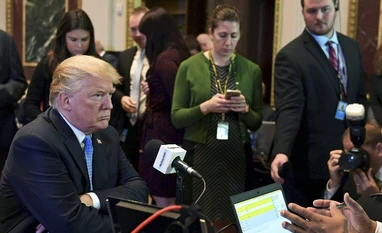 "US House passes budget blueprint, moves step closer to Trump's tax cut plan")
WebinarsNew
Deep DiveNew
Explore Business Standard
The White House and Republican congressional leaders unveiled a broad outline of the tax proposal last month
The US House of Representatives took a key step on Thursday to pave the way for deep tax cuts sought by President Donald Trump and Republican leaders, but major hurdles remained as Trump seeks his first significant legislative achievement.
The Republican-controlled House, overcoming last-minute resistance from some lawmakers in their own ranks as well as united Democratic opposition, voted 216-212 to pass a budget blueprint for the 2018 fiscal year, a measure that will make approval of an eventual tax bill easier in the Senate.
Trump, who promised major tax cuts as a candidate last year, has asked Congress to pass the tax legislation by the end of the year. Trump, who took office in January, is still looking for a first major legislative win even though Republicans control the White House and both chambers of Congress, having failed to secure a promised repeal of the Obamacare law.
The White House and Republican congressional leaders unveiled a broad outline of the tax proposal last month but detailed legislation is not due to be made public until next week.
Twenty Republicans voted against the budget measure, including several from high-tax states where many voters would be hurt by a provision of the Trump tax plan that would repeal the deduction for state and local tax payments, as well as some conservatives.
The budget plan will enable the 100-seat Senate to pass tax legislation with a simple majority rather than a 60 vote super-majority. This higher bar would be tough to reach given Democratic opposition.
Republicans hold a comfortable majority in the House but just a 52-48 margin in the Senate. Democrats have called the tax plan a giveaway to the rich and corporations that would swell the federal deficit.
The White House and congressional Republicans excluded Democrats as they developed the plan, and it appears unlikely that any significant number of Democrats will get behind the proposal.
"By passing this budget today, we can send a clear message to the American people, real tax reform is on the way," Representative Kevin Brady, the Republican chairman of the tax-writing House Ways and Means committee, said in debate on the House floor before the vote.
The Republican tax outline calls for slashing the corporate tax rate to 20 percent from 35 percent, the small business rate to 25 percent from up to 39.6 percent and the top individual rate to 35 percent from 39.6 percent.
Eliminating the state and local tax deduction, one of a series of measures to offset lost tax revenues, would hit middle-class voters in high-tax states like California, New York, Illinois, Pennsylvania and New Jersey and could remain an obstacle for some Republicans during debate on the tax measure.
During debate on the budget plan on the House floor, Republican Peter Roskam of Illinois called the state and local tax deduction a "nettlesome issue."
"I'm of the view that tax reform does not simply mean redistribution of tax liability from one part of the country to another, but it means tax relief for everybody," Roskam said.
'Silver Spoon'
Independent analysts last month forecast that corporations and the wealthiest Americans would benefit the most and many upper middle-income people would face higher taxes under the tax outline unveiled by the Republicans.
"Right here before our eyes, in this House, the Republicans are replacing the great American ladders of opportunity with the silver spoon of plutocracy and aristocracy. Their agenda raises taxes on the middle class. That is the fact," top House Democrat Nancy Pelosi said during the debate.
Independent analysts said the proposal would cut taxes for companies and individuals by up to $6 trillion over the next decade.
The battle within Trump's own party over the state and local income tax deduction offers a preview of the tough fights ahead as Republicans seek to do away with other popular tax breaks.
Another area of dispute is the possibility of scaling back a popular tax-deferred U.S. retirement savings program in order to raise revenue to pay for the sweeping tax cuts.
Trump and Brady reopened the door on Wednesday to capping annual contributions into these 401(k) plans, which for four decades have helped millions of Americans save for retirement.
First Published: Oct 26 2017 | 11:16 PM IST


 Connect with us on WhatsApp