There were many outstanding games at the Candidates. Not surprising given the strength of the field. There were also multiple errors. Part of the reason for the many errors may have been nervousness. The stakes were huge. The official prize fund of euro 600,000 (first place euro 135,000 and 8th place euro 25,000) is the least of it. The challenger is guaranteed a million dollar pay-off for the title match. Part of the reason for the errors may also have been the evenness of standard. There were no weaklings so, the winners were the players in better form on a given day.
The time control may also have contributed to error. Fide's favoured time-control is antediluvian, some 21 years after fischer unveiled the increment clock. Fide's control is move 1-40 in 120 minutes, move 41-60 in 60 minutes, and 15 minutes for the rest of the game, with 30 seconds per move increment starting at move 61.
Long games are more commonly played with an increment from move 1. One common system is 100 minutes for move 1-40, with 30 seconds increment from move 1, and 50 minutes for move 41-60, at the same increment. Anecdotally, every strong player seems to be in favour of increments from the beginning. Everybody seems to claim that time pressure stress and stupid errors are much less common.
The mathematical difference is trivial but it makes a very non-trivial difference in playing terms. The increment enforces time-management and flag-outs are much less common. It is not uncommon for a time scramble to be played out with both players on increment down to their last seconds. But the increment eliminates the ridiculous situations where somebody must make 15 moves in 20 seconds. A player down to the last second gets 30 seconds for the next move.
Once you have gotten used to increments, re-adjusting to non-increment controls is very hard. In the last Candidates, the Ukrainian genius, Vassily Ivanchuk flagged out several games precisely due to this. Nobody flagged out at Khanty but there were a lot of errors between move 30- move 40.
Mistakes like the following are inexcusable however under any control.
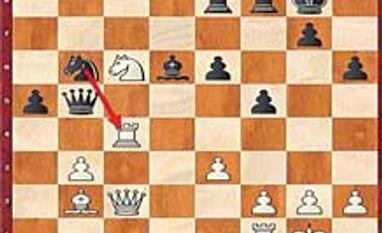
In THE DIAGRAM, WHITE TO PLAY (Vladimir Kramnik Vs Peter Svidler Candidates 2014), black has one obvious threat (marked by arrow). Both players had about 5 minutes to reach move 40.
32.Rd4?? White has only one sane defence. But 32.Nd4 Qe5 33.Nf3 Qb5 34.Rc3 leaves him with a decent position. Black was incredulous but accepted the gift with
32...Bxh2+ 33.Kxh2 Qxf1 34.Qc3 Rf6 35.Ne5? Qxf2 36.Rf4 Qe2 37.Qd4 Nd5 38.Rf3 38 Rc8 39.Rg3 f4! (0-1) Slaughter with Rxf4-Rh4 coming up. White had 59 seconds left on his clock when he resigned.
Devangshu Datta is an internationally rated chess and correspondence chess player

 "Chess (#1092)")


 Connect with us on WhatsApp