In mid-January, online start-up publication Inc42 organised a three-day event in Jaipur, which aimed at connecting investors with start-ups and mentors. The paid event was attended by 300 people, including representatives of several business families keen to understand the asset class.
When Sasha Mirchandani, founder of Kae Capital, raised his first fund in 2010, there were only a few family offices in the country. Today, when he’s raising his second fund, he finds several family offices across Mumbai, Bengaluru, Delhi and Chennai. They are contributing 40 per cent of the second fund he’s raising versus five per cent for the first fund.
Family offices have become more active in India and emerged a key source of early-stage venture capital in India.
They contributed 30-40 per cent of the money raised by several maiden venture capital funds last year, many of which hit the market at the same time — Stellaris Ventures, Pravega Ventures, Endiya Partners, and Fireside Ventures.
Unicorn Ventures has raised 40 per cent of its Rs 100-crore maiden fund from family offices. ‘‘We have reached out to family offices who did not know how to get into start-ups,” says Bhaskar Majumdar, co-founder. It has managed to rope in families in construction, chemicals, are keen on getting an exposure into start-ups as an asset class.
The number of family offices investing in start-ups has also gone up. Unicorn has attracted money from the Birlas, as well as the Mundhra family managing Simplex Industries.
A Delhi-based family in tobacco business, says Majumdar, is keen to invest Rs 25 crore for the next four years.
In many family-owned mid-tier companies, the new generation, which has studied abroad, does not want to take over the reins. The families, says Majumdar, want to set up the next generation by giving them access to deal flow in start-ups. After investing directly in start-ups, many of these families are now trying to invest through VC funds.
The Patni brothers, Arihant and Amit Patni, were amongst the first to set up a family office in 2003-04, after General Atlantic acquired 17.4 per cent stake in Patni Computers for $100 million. The company was eventually sold to iGate for $1.22 billion in 2011. The Patnis actively invest in start-ups and also manage two VC funds.
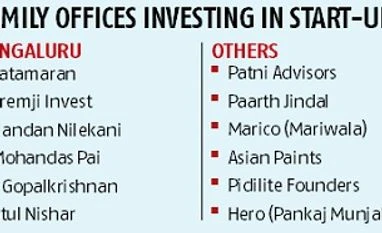
Other family offices actively investing in start-ups include Catamaran Ventures (Narayana Murthy), PremjiInvest (Azim Premji), the Mariwala and the Burman family, Infosys founders Nandan Nilekani, Mohandas Pai, S Gopalakrishnan and S D Shibulal. There are others like Anupam Mittal, Anand Ladsaria, and Ashotosh Taparia who invest in start-ups.
Family offices have steadily evolved in India in the last five years. ‘‘Entrepreneurs who have had successful exits in the recent past are setting up teams comprising of experienced professionals to help them invest, manage, organise and administer the funds to ensure growth for future generations,” says Arihant Patni of Patni Advisors. This structured approach is comparable to what happens with large families in the West.
‘‘Start-up investing has become a significant area of interest by these family offices. Having been set up largely by first or second generation entrepreneurs, there is a strong DNA within the system to participate early in these young companies and generate disproportionate returns,” he added.

 "Family offices warm up to start-ups, venture capital")












 Connect with us on WhatsApp