So often in every sport there emerges that one extraordinary athlete whose physicality towers above his peers'. A sense of machismo never seen before, intense and almost irrepressible. When Usain Bolt annihilated a star-studded field in the 100m and 200m at the 2008 Beijing Olympics and smashed both world records, you knew that here was a man who, along with being freakishly talented, was a rare physical phenomenon who would take some thwarting. Not since Michael Johnson had stormed his way into the sunset had the world seen a sprinter so powerful and seemingly invincible.
But long before that balmy Beijing evening at the Bird’s Nest, the world of tennis was confronted with a physical specimen of its own -- a certain Rafael Nadal. With his long hair, sleeveless shirt, capri pants and bulging biceps, the teenager from Mallorca in Spain looked a typical street fighter. Opponents watched in wonderment as Nadal -- or Rafa, as he is called on the circuit -- retrieved one shot after another, slowly turning defence into offence, before unleashing a ferocious forehand with his trademark “lasso-whip” follow through.
Roger Federer was sublimely talented, but Nadal introduced us to a brand of tennis that was spunky and implacable at the same time. Fourteen Grand Slams titles and several years later, the hair and the shorts may be visibly shorter, but little has changed in the way Nadal approaches the game. But the physicality of his game has taken its toll, and damage is slowly showing.
This past week, at the Qatar Open in Doha, Nadal crashed out to Michael Berrer, with a world ranking of 127, in his first competitive match since returning from appendicitis surgery. Earlier this month, the Spaniard was dismantled 6-2, 6-0 by Andy Murray in the semi-final of the exhibition Mubadala World Tennis Championship in Abu Dhabi. Against Berrer in the first round in Doha, there were sporadic flashes of brilliance from the 28-year-old. The around-the-net forehand he whipped from the baseline in the second game of the match could have easily been nominated for the shot of the tournament. But as the match went deeper, there were clear signs of the world no 3’s waning physical power. Dustin Brown, Nick Kyrgios, Martin Klizan, Feliciano Lopez, Borna Coric and now, Berrer -- if these are players you have hardly heard of, you could be forgiven, but they are the unheralded names he has succumbed to in his last six official events.
Nadal played just seven matches last season, mainly due to wrist and back problems, and then the appendicitis. After the defeat to Berrer, he expressed doubts over his participation in the Australian Open, which starts in Melbourne from January 19. He also declined offers to play in preparatory tournaments in Auckland and Syndey. All of a sudden, there were talks of not just a decline, but the end of a mesmerising career.
So will we ever see the best of Nadal again? Historically, Nadal has coped well with injury. The 2012 season saw him pull out of several tournaments due to debilitating knee problems. In 2013, Nadal completed one of the greatest comebacks in modern sport, winning 10 titles, including a record eighth French Open and the US Open. Nobody will be surprised if Nadal comes roaring back and makes a grab for the world no.1 rank again, but the chances look scant.
Some would argue that Federer is 33 and still going strong, so why can’t Nadal, five years his junior, bounce back? Here’s why. Over the last few years, Federer has modified his game to sync it with his dwindling physical capabilities. No longer do we see Federer break his back with arduous rallies from the back of the court. He tries to keep the points short, and of late has started employing the serve and volley to great effect. When in ascendancy during matches, it’s normal to see Federer drop his intensity and try out a few different things. With Nadal, the pace is invariant. The last point is played with the same earnestness as the first. The gruelling groundstrokes are hit with the same venom throughout. And the lung capacity and the athleticism are always stretched to capacity.
But there will come a point in Nadal’s career when this relentless, all-out style of tennis will slowly lose its efficacy. With age, the injuries will pile up and Nadal will have to find a way to overcome his physical weariness and tweak his game accordingly. With Novak Djokovic strong and steady at the top and Murray slowly making his presence felt again, Nadal looks at a tough 2015. A charge to the summit seems unlikely, but wouldn't we love to be surprised?

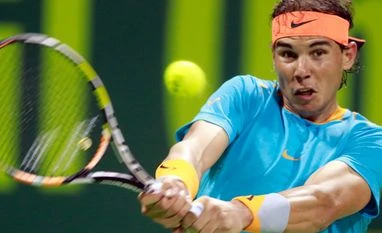 "Rafael Nadal's spirit is willing, but the legs are tiring")


