Meet resilient Indian women breaking stereotypes on the football field

In a first, four Indian women in the list of FIFA International Referees
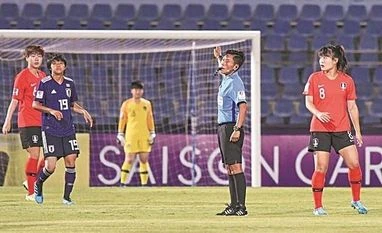
Women Football
Mental strength and confidence are critical for women referees to survive in what still remains a man’s world
Geetanjali Krishna New Delhi
5 min read Last Updated : Nov 02 2020 | 6:10 AM IST
A short-haired woman stands in the centre of a football field. The players file in. Some smirk as she blows the whistle. They’ve never seen a female match referee. But through the next 90 minutes of play, she runs alongside the players constantly, keeping check on their every move. Tempers run high as she makes a controversial decision, but she remains calm.
 
Meet 35-year-old Ranjita Devi Tekcham, awarded the FIFA Referee Badge in 2018. From Khongjom Bazar in Thoubal district of Manipur, she’s spent her life challenging stereotypes, on and off the field. So has 27-year-old Kanika Barman, who in 2014 made history as the first woman to officiate a major league football match between Mohun Bagan and East Bengal in football-crazy Kolkata.
 
Barely out of her teens at the time, she recalls feeling nervous but elated that she was shattering the glass ceiling that had deterred so many women from pursuing careers in sports.
 
In a boost to women’s football in India, the duo is among the four women selected as International Referees by the Fédération Internationale de Football Association, or FIFA, recently. The other two — Meghalaya’s Riiohlang Dhar and Goa’s Uvena Fernandes — have been selected as assistant referees.
 
“It’s the first time FIFA has selected four Indian women for this honour; usually they don’t select more than two,” says Dhar. “It’s a huge opportunity for all of us.”
 
Indeed, women referees in India have often been starved of live matches to hone their skills as the All India Football Federation (AIFF) doesn’t yet allow female referees to officiate men’s matches except for some state-level ties. However, the freshly-minted FIFA referees attest that things are changing now.
 
In the FIFA U-17 World Cup 2017 held in India, international football history was made when the first female referee, Switzerland’s Esther Staubli, officiated a men’s match. “In India now, there are many more tournaments than before, especially in Meghalaya, which now has some great football clubs,” says Dhar. She’s officiated matches in South Africa, Lebanon, Vietnam, Kyrgyzstan and other countries.
 
Fernandes — the first Indian woman assistant referee to officiate in a World Cup, the 2016 U-17 Women’s World Cup in Jordan, has also officiated as an assistant referee in the FIFA Under-20 Women’s World Cup in France in August 2018.
In fact, after the rigorous FIFA fitness test in Chennai, the AIFF director has reportedly agreed to give them the chance to hit the men’s fitness timings. This could finally open up opportunities to officiate men’s matches in India as well.
 
“This is all very good news for women footballers,” says Tekcham. “Officiating matches gives women the chance to remain in football at least till the age of 45.” Dhar for example, used to be a national level player who took a break from football in 2008 to concentrate on her board examinations. “One year later, when I wanted to rejoin, it was hard to find opportunities,” she says. “A coach asked me if I’d like to become a referee instead and I jumped at the opportunity to stay on the field for some more time.”
 
Maintaining the fitness levels required for football can sometimes prove tough for women. Barman actually trained to play at the national level within a year of becoming a mother. “Having had to undergo a Caesarean section, I was not allowed to do my training for the first eight months,” she recounts. When her baby was 11 months old, she sent her to live with her parents so that she could train in earnest. “It was very hard but I’m happy I did it,” she says.
 
Tekcham, too, was a state-level player till a long illness halted her game for several months. She became a state class III referee in 2007 and then the second Manipuri woman after Keilyani Chanu to become an international FIFA referee.
While physically less taxing than actually playing the game, refereeing isn’t for the faint of heart. “Invariably during the match, tempers run high,” says Barman. “Players sometimes challenge my decisions, sometimes even hurl abuses… But with experience, one learns to handle this.”
 
Mental strength and confidence are critical for women referees to survive in what still remains a man’s world. “To be physically fit is important,” says Tekcham, “but one’s ability to ignore the backlash from players and spectators is critical.”
 
Dhar and Tekcham are constables in their respective state police battalions, while Barman is a civic volunteer with Kolkata police. As FIFA referees, they will receive up to $500 per day during tournaments, much more than what they earn in domestic matches where their fees range between Rs 200 and Rs 350 a day.
 
“So far, thanks to the Covid-19 pandemic, the year has been a washout,” says Barman. “Hopefully, the coming year will be an exciting one for women’s football in India.”
 
On side
 
Ranjita Devi Tekcham (35)
 
Constable with Manipur police; second woman from state, after Keilyani Chanu, to become international FIFA referee
 
Kanika Barman (27)
 
Civic volunteer with Kolkata police
 
Riiohlang Dhar (30)
 
Constable (pictured below) with Meghalaya Police; first referee from the state to make it to the FIFA panel
 
Uvena Fernandes (39)
 
From Goa; was the first Indian woman assistant referee to officiate in a World Cup, the 2016 U-17 Women’s World Cup in Jordan; has also officiated as assistant referee in the FIFA Under-20 Women’s World Cup in France in 2018

One subscription. Two world-class reads.

Already subscribed? Log in

Subscribe to read the full story →
*Subscribe to Business Standard digital and get complimentary access to The New York Times

Smart Quarterly

₹900

3 Months

₹300/Month

SAVE 25%

Smart Essential

₹2,700

1 Year

₹225/Month

SAVE 46%
*Complimentary New York Times access for the 2nd year will be given after 12 months

Super Saver

₹3,900

2 Years

₹162/Month

Subscribe

Renews automatically, cancel anytime

Here’s what’s included in our digital subscription plans

Exclusive premium stories online

  • Over 30 premium stories daily, handpicked by our editors

Complimentary Access to The New York Times

  • News, Games, Cooking, Audio, Wirecutter & The Athletic

Business Standard Epaper

  • Digital replica of our daily newspaper — with options to read, save, and share

Curated Newsletters

  • Insights on markets, finance, politics, tech, and more delivered to your inbox

Market Analysis & Investment Insights

  • In-depth market analysis & insights with access to The Smart Investor

Archives

  • Repository of articles and publications dating back to 1997

Ad-free Reading

  • Uninterrupted reading experience with no advertisements

Seamless Access Across All Devices

  • Access Business Standard across devices — mobile, tablet, or PC, via web or app

Topics :footballFIFA

Next Story


