For the uninitiated, kabaddi, the ancient Indian game that is taking the world’s second-most populous country by storm, looks far too simple to be a professional sport.
A hybrid of rugby, touch football and the playground game known in England as British Bulldog and in the United States as Red Rover (“Red rover, red rover, let Tommy come over...”), kabaddi (pronounced kuh-bud-DEE) uses no balls, pucks, nets, goal posts, hoops, holes, rackets, clubs, sticks or bats. It is so unknown in the West that on August 8, 2017, ESPNU, the American digital cable and satellite sports television channel owned by ESPN Inc., showcased what it termed “the finest in seldom seen sports,” including the 2016 Kabaddi World Cup Final. An exhibition match was played at the 1936 Olympics in Berlin, but it did not catch on internationally.
Now, with the establishment in 2014 of the Pro Kabaddi League (PKL) and television coverage, as the league’s sixth season is set to begin on Sunday, the sport has captured Indians’ hearts, souls and TV remotes. Its popularity as a spectator sport is now second only to the British import cricket, which Indians still worship with near religious fervor. Last year some 313 million TV viewers watched league matches, according to Indian TV viewership surveys.
Given kabaddi’s recent gains, it should continue to penetrate the Indian market and may eventually even garner attention in the West.
“Kabaddi is a compelling gladiator-like sport — one man heroically pit against seven — with such old associations in India that I was immediately taken in,” said Ronnie Screwvala, the Indian multimedia entrepreneur who was the first person to acquire a team, U Mumba, when the league launched in 2014. “Indians have needed something they can claim as only theirs.”
The game got a dressing up since its rural mud field days when Star TV India, an Asian television service owned by 21st Century Fox, teamed up with the league, which is owned by Mashal Sports, a Bangalore-based sports management company. Last year Star sold a 5-year sponsorship to Vivo, a Chinese technology company, for $47 million, that was the league’s first corporate tie-in.
The challenge for Star TV “was unique in the history of televised sports,” said Uday Shankar, chief executive of the Indian channel. “For a spectator sport in its embryonic stages, we’ve had to invent vocabulary for commentators, find directors who’ve had parallel experience, mostly from rugby, tweak some rules to make it TV-friendly, and even figure out what stats fans would want to track.”
Star also made the game more visually appealing for TV with flashing neon signage and smoke machines in arenas. Costumed crowd-rousing mascots bounce around before games and during breaks in the action. At least a dozen cameras catch it all.
Mr. Screwvala gave his players a fashion makeover, “to make them look more appealing.” They got stylish haircuts and Oakley goggles to wear when not competing.
Cumulative viewership for PKL matches rose from 217 million for Season 4 to 313 million for Season 5, according to Partho Dasgupta, chief executive of India’s Broadcast Audience Research Council.
PKL’s Season 5 finale was the best rated non-cricket event on TV, with 26.2 million kabaddi viewers versus 55.6 million cricket fans, Mr. Dasgupta said.
U Mumba also acquired Iran’s Asian Games gold-winning coach, Amir Gholamreza Mazandarani, the first-ever foreign coach in the PKL.
Of the 239 players selected to play for PKL’s 12 teams, each team consisting of 18 to 24 players, 26 players come from some 14 Asian countries other than India, including South Korea, Iran, Bangladesh, Taiwan, Kenya, Indonesia, Sri Lanka, Japan, Oman, Nepal, Thailand, Mauritius and Malaysia.
“This much foreign involvement in an India-born sport bodes very well for the sport here at home,” said Mr. Screwvala. “In business, open competition always makes the good even better.”
An avid fan, he is often in the front row at U Mumba contests, with his wife Zarina and daughter Trishya Screwvala, all three jumping from their seats, cheering loudly at each score or tackle.

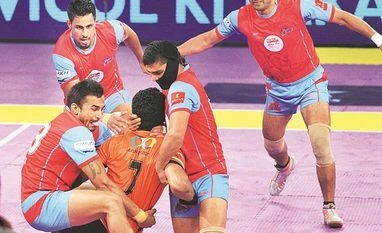 "Pro Kabaddi League: A televised spectacle capturing the heart of India")












