Indian automobile units employing robots to improve your car's efficiency

India is catching up well as world over, the latest technologies is redefining outdated manufacturing processes
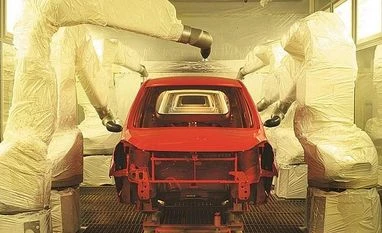
Hyundai's automated multi-model paint shop at Sriperumbudur can handle multiple colours in the same line without the need for a setup change
TE Narasimhan
Last Updated : May 17 2018 | 7:00 AM IST
The Hyundai plant in Sriperumbudur in suburban Chennai doesn’t conform to the old-fashioned image of a factory with greasy floors and deafening noise. Instead, it looks clean and welcoming. The rows of brand new cars indicate that the factory is working at full tilt. The plant churns out one car every 30 seconds. And this is thanks not only to the men in blue coveralls who work here. Toiling side by side with the humans are a bunch of yellow-hued robots that help ramp up the unit’s efficiency and productivity.

A few hundred kilometres away, Honda's two-wheeler plant near Narsapura in the outskirts of Bengaluru also uses robots to improve efficiencies. Indeed, most automakers who have set up manufacturing plants in India are resorting to automation to boost their productivity. 

At Hyundai's Sriperumbudur factory, where 580 robots are in use, the defect ratio has dropped from five per cent to less than two. This plant is in the Top 5 in the Qualitivity charts (Quality + Productivity) amongst Hyundai Motor Group’s (HMG) 32 plants worldwide. It was also HMG’s Number 1 performing overseas plant and the No 1 Safety Plant in 2017.

Says S Ganesh Mani, vice-president, production, Hyundai Motor India Ltd (HMIL), “Our strategy is to use automation to minimise and eliminate dirty, dull and dangerous jobs and to improve overall efficiencies.”

Other auto manufacturers are also using automation in a big way. Sources say that Maruti Suzuki India Ltd now has one robot for almost every four workers and that it has some 5,000 robots at its Manesar and Gurgaon plants.

Earlier, welding guns used to be operated manually in the body shop of an auto manufacturing unit. However, as welding became more sophisticated and the guns got heavier, manual operation became tougher. Robots are perfect for this function. They are also employed to conduct quality checks on the engine of a car using the high-speed Vision system. 

Currently, HMIL’s body shop is more than 95 per cent automated and its paint shop is 65 per cent automated. HMIL has been enhancing automation levels year on year by migrating from third to fourth generation robots.

Honda’s new two-wheeler manufacturing unit near Bengaluru is fully automated as well. For example, where earlier humans picked up material from one machine and fed it into another, this task is now done via a robotic hand, from end to end. Thanks to automation, the line that was earlier manned by around 10 workers has upped its productivity with just three or four workers, reveals V Sridhar, group vice president and director, Honda Motorcycle & Scooter India Pvt Ltd (HMSI).

In fact, the productivity of this plant is 20 to 25 per cent higher than Honda’s first two-wheeler plant in India, which is minimally automated.

The use of automation on the factory floor is no longer sporadic, though.

The world over, Industrie 4.0 — the latest technologies in automation and data sharing in manufacturing — is redefining outdated manufacturing processes. And India is catching up as well.

"We have many smart sensors installed in the machine, which keep track of various operations,” says Sridhar.

For instance, a bearing condition monitoring robot will monitor the temperature of the bearing, take the feedback to the control panel, and thus save the time taken to put the machine back into production. This results in a five to seven per cent increase in asset utilisation, Sridhar explains. HMSI has introduced automation to forecast and pre-empt machine breakdown at its third factory near Bengaluru and plans to extend it to its other units soon.

In fact, the emergence of Collaborative Robots (Cobots), which can work with humans has hugely extended the use of robotics on the shop floor. “In the past only big automotive companies used robots. But with Cobots, it has became affordable for small industries and component manufacturers as well,” says Pradeep David, country head (India & Sri Lanka), Universal Robots, which is a pioneer in Cobots.

Market intelligence firm IDC estimates that by 2020 nearly two-thirds of all work in factories will be done by Cobots.

Would that make human workers redundant? Not necessarily. Companies say that they are now upskilling employees to manage robots and troubleshoot online. The gains of automation are clearly too big to ignore and eventually society will have to find the best human-machine balance for optimising manufacturing processes.

One subscription. Two world-class reads.

Already subscribed? Log in

Subscribe to read the full story →
*Subscribe to Business Standard digital and get complimentary access to The New York Times

Smart Quarterly

₹900

3 Months

₹300/Month

SAVE 25%

Smart Essential

₹2,700

1 Year

₹225/Month

SAVE 46%
*Complimentary New York Times access for the 2nd year will be given after 12 months

Super Saver

₹3,900

2 Years

₹162/Month

Subscribe

Renews automatically, cancel anytime

Here’s what’s included in our digital subscription plans

Exclusive premium stories online

  • Over 30 premium stories daily, handpicked by our editors

Complimentary Access to The New York Times

  • News, Games, Cooking, Audio, Wirecutter & The Athletic

Business Standard Epaper

  • Digital replica of our daily newspaper — with options to read, save, and share

Curated Newsletters

  • Insights on markets, finance, politics, tech, and more delivered to your inbox

Market Analysis & Investment Insights

  • In-depth market analysis & insights with access to The Smart Investor

Archives

  • Repository of articles and publications dating back to 1997

Ad-free Reading

  • Uninterrupted reading experience with no advertisements

Seamless Access Across All Devices

  • Access Business Standard across devices — mobile, tablet, or PC, via web or app

Next Story



