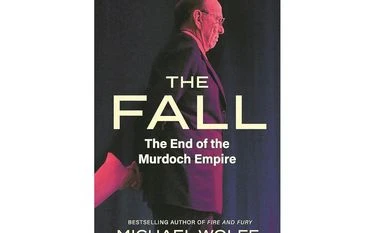
The Fall: The End of the Murdoch Empire
Publisher: The Bridge Street Press
By 1991, Rupert Murdoch had almost lost News Corporation to the debt that piled up on the way to creating BSkyB. Just when the company was limping back to financial health, he blew over $870 million on Star TV, the only pan-Asian broadcaster then. It took nine years for Star to succeed in India. In the process it brought Channel [V], India’s first music channel (1994), Star News, its first news channel (1998), Radio City, the first private radio station (2001). It helped Amitabh Bachchan’s return to stardom thanks to Kaun Banega Crorepati (KBC) in 2000 and changed the rules of television. It revived an ancient Indian game through the Pro Kabaddi League and created India’s largest pay streaming app with Disney+Hotstar. Thirty years later, it still dominates with a 22 per cent share of all TV viewing. At over Rs 17,000 crore in revenues (now) Disney Star is among India’s largest media firms. In 2018, when Disney bought out News Corp sibling Twenty First Century Fox’s entertainment assets, Star India was valued at $13-15 billion.
This is the Murdoch I know. I have never met him. But the man who emerges from two decades of covering media and dozens of interviews with his former lieutenants and managers is the one described in the paragraph above. He (along with Subhash Chandra) evangelised broadcasting in India and created an entire ecosystem around it. He is a cussed old man who refuses to see reason when he’s had an idea or spotted a market.
That is why Michael Wolff’s The Fall: The End of the Murdoch Empire, which traces the last two or three years of Mr Murdoch’s media empire — essentially News Corporation and Fox Corporation — is a huge let-down. The Murdoch in this book is an incomprehensible, 92-year-old who cannot seem to communicate with his managers, children and wives. How on earth did he create one of the world’s largest and most interesting media firms for which The Walt Disney Company paid $71 billion?
Mr Wolff’s professional pedigree is excellent. Besides a trilogy on former US president Donald Trump, he’s authored two books on Mr Murdoch, including a biography. He writes for Vanity Fair, The Guardian and several other publications. Some of his analysis, especially on the power play between Mr Murdoch, the (late) Roger Ailes, the reviled former CEO of the ultra-right-wing Fox News and the whole free speech question, is brilliant.
His access to Mr Murdoch’s inner circle is something else. It is almost like he’s been a fly on the wall at parties and family get-togethers. He understands the nuances of the news business, the politics of it and the politics of America. And juxtaposes it well with Fox News, with which this book seems obsessed. That is my first issue with the book.
It is less about Mr Murdoch and the downsizing of his business and more about Fox News. Mr Wolff goes into obsessive details about Tucker Carlson, Sean Hannity, Ailes, Suzanne Scott (current CEO) and other key characters at Fox News, their motivations, their thoughts, their relationship with Mr Murdoch and his sons Lachlan and James. He goes on and on about Fox News building up to the Dominion Voting Systems lawsuit. In 2021, the company had filed a defamation suit against Fox News for broadcasting that its machines had been rigged to steal the election from Donald Trump. Eventually Fox settled the suit by paying $787 million and accepted that it had broadcast lies.
But the downsized Murdoch empire is still about $24 billion in revenues (FY23). Of this, $10 billion is from News Corp from brands such as The Sun, The Times, Wall Street Journal, HarperCollins, over half a dozen newspapers and Foxtel in Australia, among others. And there is the $14 billion Fox Corporation, which houses its cable and TV news businesses including Fox News. Why none of the other brands are of significance is not clear unless you accept that the book is meant for American readers who are, depending on how they vote, appalled or awed by Fox News.
And that brings me to the second issue with the book. It has a bitchy, gossipy tone that grates after a while. You want this sotto voce narrative to settle into the book it promises but never does. Mr Wolff doesn’t seem to have a good opinion of anybody. Going by his assessment none of the Murdochs have any brains, judgement or redeeming features. This comes through even as he purports to understand the biases of the right-wing anchors.
“So the New York Times question about whether Carlson believed what he was saying or if it was all a cynical ratings affair, which the Times clearly believed it to be, the more nuanced answer was that, while he might not much believe in lower-middle-class right-to-life, AR-15 worshipping, build-a-wall, trans-whipping blah blah, which on any given evening he might defend, he did believe that somewhere around 1929 or so the nation had begun to go terribly wrong.”
That is just one sentence, and that’s my third issue with the book. It has too many para-like sentences, too much stream-of-consciousness kind of writing. It could have done with a good editor.

 "The tabloid turns on Rupert Murdoch")












 Connect with us on WhatsApp