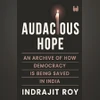
Audacious Hope: An Archive of How Democracy is Being Saved in India
Author: Indrajit Roy
Publisher: Westland Books
Pages: 256
Price: Rs 599
“Hope is crucial to democratic renewal. Far from being a wasted emotion that hinders action, hope is what motivates people to act collectively against democratic backsliding,” writes Indrajit Roy in his book Audacious Hope: An Archive of How Democracy is Being Saved in India. A professor in the department of politics and international relations at the University of York in the UK, the author firmly believes in the potential of hope to keep us committed to our values, stretch our imagination of what’s possible, forge solidarities, and build anew.
The book should be read especially by cynics already writing obituaries about the death of democracy in India. Professor Roy shows that people’s power is thriving in the country amidst all the constraints being placed on journalists, farmers, artistes, comedians, students, and religious minorities. They are not subjects bowing down passively in the face of authoritarianism. They are citizens who cherish their rights and freedoms; who take their responsibilities seriously.
“Sadly, it is a fixation on collapse that beguiles much of [Prime Minister] Modi’s opponents in India,” writes Dr Roy, whose book is an inspiring record of alliances, collectives and movements to uphold democracy that have emerged all over India since the Bharatiya Janata Party (BJP) came to power in 2014. The book cover, designed by Saurabh Garge, reinforces this point with a simple but powerful visual of a candle flame spreading light amidst the darkness.
This book reminds us that there is more to a democracy than fielding candidates for elections, getting people to vote for them, and forming a stable government. Democracy, as Dr Roy articulates so elegantly, “is a social process in which people can assert their equality before one another and before the law”. He celebrates, for instance, people across religious backgrounds who gathered at Shaheen Bagh to protest against the Citizenship Amendment Act because they found it unacceptable that some Indians were treated as less Indian than others.
Apart from noting the contributions of newsmakers such as Rohith Vemula, Kanhaiya Kumar, Umar Khalid, Chandrasekhar Azad Ravan and Munawar Faruqui, who have become household names, the book also draws attention to the unsung efforts of people such as Chinglen Kshetrimayum from Manipur who wrote an open letter highlighting the problem of militarisation on university campuses because of the Armed Forces (Special Powers) Act.
The hope that Dr Roy talks about is not a search for utopia or a magical resolution of problems. It is a wellspring of courage in the most challenging of times. Hope is not an escape from reality. It is grounded in taking stock of the present, and working towards a desired future.
This book urges us to view the political environment in India in relation to what is unfolding in Turkey, Hungary, Brazil, the Philippines, South Africa, and the United States. These are countries where “elections are routinely conducted and their verdicts respected”, and this makes it hard for critics of the government to argue that democracy is under attack. He notes that Narendra Modi, unlike “interwar European fascist demagogues who pointedly reject democracy”, takes pride in “proclaiming India’s democratic lineage” in election rallies for domestic audiences, both houses of Parliament, and international audiences at global forums.
That said, Dr Roy has not found much hope in Rahul Gandhi of the Indian National Congress. He recalls attending a meeting in London in March 2023 where Mr Gandhi addressed parliamentarians, academics and community leaders. Mr Gandhi spoke about the persecution faced by minorities, India’s economic challenges, and how the Bharat Jodo Yatra helped him understand the issues that people were dealing with, but he offered no road map for the future.
The author writes, “Gandhi’s audience craved hope to help them navigate the ambiguous possibilities of a new India. All he presented them was a futile lament on the passing of the old India. Such an approach is simply not fit for purpose if he seriously intends to lead the battle to save India’s democracy.” This well-worded critique might also benefit intellectuals who are stuck in singing the glories of India’s Nehruvian era. Amidst our disenchantment with the present, we look to the past for comfort and pretend that it was picture perfect. Hope, as this book constantly prods us to keep in mind, is about rising up and moving forward.
The author draws his ideas from a range of thinkers including Raymond Williams, Hannah Arendt, Ernest Bloch, Paulo Freire, Henri Desroche, Mary Grey, Les Back, bell hooks, José Esteban Muñoz, and David Harvey. But he does not reflect much on where ordinary Indians who have no access to these intellectual resources draw hope from and why they risk their own lives during a riot or a pandemic to protect someone else. Does this respect for human dignity come from living in a democracy? Is it nourished by the faith that people follow? Or is there something fundamentally universal about wanting to relieve others of their suffering?
The reviewer is an independent journalist and educator based in Mumbai. He is @chintanwriting on Instagram and X