Quoting Rabindranath Tagore on how a self-sustaining village can make a mark in democracy, the Economic Survey, tabled in Parliament on Monday, has expressed concern over increased dependence on revenue devolution instead of self-generation.
While previous government policy statements have focussed on a cooperative federalism, the underlying theme of goods and service tax (GST), the Survey this time talks about fiscal federalism. It acknowledges there is an important legal argument that resources received by the states as part of successive Finance Commission verdicts are not “devolved” resources, but shared.
In this view, the Centre is merely collecting taxes in a divisible pool on behalf of the states, and sharing it with them. But, this position, the Survey says, must be assessed against certain realities.
It is difficult to dispel the association (in the eyes of taxpayers) of the Centre with income taxes and customs duties that form a major part of the divisible pool. If the Centre were a mere collecting agency, the funds would be apportioned according to states’ tax bases. They would not have sizeable redistributive components.
Also, the new GST provides a sharp contrast — it is clearly more “shared” because decisions and tax administration are done by both.
The fiscal model of the states and third tier institutions at the central level could forever be based on outside resources which -- like foreign aid and natural resources or other forms of ‘redistributive resource transfers’ — come with weak accountability mechanisms and weak own resource generation capacity. “In the context of growing decentralisation of economic and political power, how to break this equilibrium could well be one of the more pressing issues confronting fiscal federalism going forward. Indian policy makers can perhaps no longer avoid this question: should vertical and horizontal resource devolution to second and third tier fiscal institutions be credibly linked to their performance in increasing reliance on own taxes, especially direct taxes?,” the survey says.
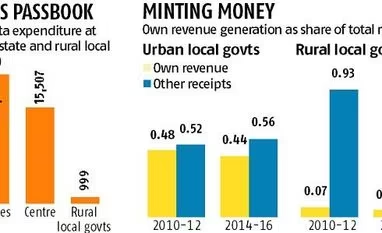
The central and state governments spend on an average 15- 20 times more per capita than rural local governments. Urban local governments spend about three times more. This gap has persisted over time despite per capita spending by RLGs increasing almost four-fold since 2010-11.
ULGs appear to be doing much better in terms of own revenue generation. They generate about 44 per cent of their total revenue from own sources. RLGs, in contrast, rely overwhelmingly (about 95 percent) on devolution.
State and local governments rely much more on devolved resources and less on their own tax resources, and they collect less direct taxes. “And, the reason does not seem to be so much that they don’t have enough taxation power. Rather, the bigger problem is that they are not fully utilising the taxation powers they already possess,” observes the Survey.

 "Economic Survey: Link tax sharing to resource mobilisation by state govts")












 Connect with us on WhatsApp