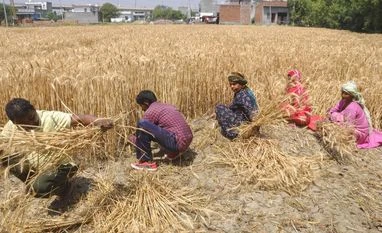
Nearly four decades since its last iteration, the central government is planning to revise the base year of the consumer price index for agricultural labourers/rural labourers (AL/RL) to better capture price increases experienced by these categories of workers.
The base year revision is part of a broader effort by the government to introduce new series for several key macroeconomic indicators, including the Index of Industrial Production (IIP), Gross Domestic Product (GDP), and the Consumer Price Index (CPI).
Currently, the base years for CPI and CPI-IW (industrial workers) are 2012 and 2016 respectively, while the base year for CPI-AL/RL is at 1986-87. The base year for CPI-AL/RL was last revised nearly three decades ago, in November 1995.
For this purpose, the Labour Bureau has constituted an expert committee, chaired by National Statistical Commission (NSC) member Asit Kumar Sadhu, to shift the base year from 1986-87 to the 2024-25 agricultural year. The expert committee will also include representatives from the consumer affairs and statistics ministries, as well as independent experts. The recently released Household Consumption Expenditure Survey (HCES) is being used for this purpose.
“The 1986-87 base year is too outdated now. There has been a sea change over this period. The country has moved forward, and consumption patterns have changed. Unless the indices are revised, they won’t reflect actual consumption patterns. Most importantly, they won’t capture rural and agricultural wages, which are largely linked to them,” a senior government official told Business Standard.
Arun Kumar, former professor at Jawaharlal Nehru University, said the two indices are crucial because the general headline retail inflation figure does not accurately represent a large segment of the rural population, given their distinct consumption patterns.
“Low-income people, especially in rural areas, spend most of their earnings on food, which is very different from the way people in urban areas or with higher incomes spend. While the current index, based on 1986-87 is obsolete, we still need a different index to compute inflation as experienced by these sections of the population. It's a welcome move that the government is changing the base year,” he added.
Effect of outdated base year
Shifting the base year for these two indices is important as these indices are used to determine minimum wages for agricultural and rural labourers (engaged in either agricultural or non-agricultural work) by both the central and state governments.
K R Shyam Sundar, professor of practice at MDI, says that the non-revision of base years has resulted in continuation of the lopsided weightage being assigned to food items in the current series.
“This has resulted in neglecting the actual price changes that have occurred in other important consumption items like education and health, among others, resulting in lower inflation being recorded against these categories. This implies that the minimum wages being set by successive governments have been lower during this time,” he added.
Under the current base year which uses the National Statistics Office' (NSO) 1983 household consumption expenditure survey, food items have a weighting of 72.9 per cent in the present CPI-AL and 70.4 per cent in CPI-RL. Other important consumption components, such as medical care, have a weightage of only 4.38 per cent in CPI-AL and 4.23 per cent in CPI-RL. Meanwhile, ‘Education, Recreation, and Amusement’ has a minuscule weightage of 0.94 per cent in CPI-AL and 0.99 per cent in CPI-RL.
Once the latest household consumption expenditure survey is used to calculate new series, the weighting composition of different items will change.
Also, CPI-AL is used to determine wages under the government’s flagship rural jobs programme — the Mahatma Gandhi National Rural Employment Guarantee Act (MGNREGA). In 2009, the MGNREGA wage was first indexed against the CPI-AL.
The Mahendra Dev committee, set up in 2013 to look at the MGNREGA wages afresh, recommended in its 2015 report that the wages should be indexed against CPI-R instead, since CPI-AL and CPI-RL (Consumer Price Index-Rural Labour) were outdated. In CPI-Rural, food items account for only 59 per cent and it also provides for higher expenditure on education, medical care, and transport and communication. However, the recommendations were not implemented by the government as the Ministry of Finance expressed concerns over the potential fiscal implications of adopting CPI-R for wage indexation.
As a result, the MGNREGA wages in a number of states currently are lower than the statutory minimum wages set by both the states and central government.
Impact of Revision
Mahendra Dev, professor at Indira Gandhi Institute for Development Research (IGIDR) who headed the eponymous committee mentioned earlier, says that the two indices with 1986-87 as a base year have hidden the actual inflation rate experienced by these workers.
“First, they have a disproportionate weightage of food. Second, the government provides subsidised food to almost all the rural population. This results in reporting of an inflation rate which is quite lower than the actual rate. With the new series, the weightage given to different items will get rejigged for sure,” he added.
He further added that since the government didn't accept the proposal to delink MGNREGA wages from CPI-AL a decade back, it will now be possible to offer higher wages under the scheme as the new series will better capture the inflation. Also, the minimum wages set by both the central and state governments are also expected to see an increase which uses these indices, he added.