Govt policy tailwinds to drive 15% CAGR in India's defence production

The government's ongoing policy push for import substitution and exports is a big propellent, driving the 15 per cent CAGR in India's defence production turnover
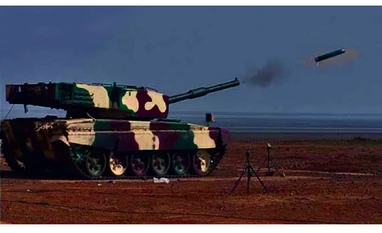
DRDO, Laser Guided Anti Tank Guided Missile
Ajai Shukla
4 min read Last Updated : Nov 13 2023 | 11:40 PM IST
Amidst rising defence spending by East European and West Asian countries, a new report from Axis Capital Research focuses on India’s defence production and indigenisation programme. It predicts that the compounded annual growth rate (CAGR) of India’s defence outlay is likely to grow at 12 per cent to $147 billion over FY2025-29E.

The Axis report draws on the data from India’s annual Budget, the Ministry of Defence (MoD) media releases, the World Bank and international bodies such as the Stockholm International Peace Research Institute (SIPRI).

The government’s ongoing policy push for import substitution and exports is a big propellent, driving the 15 per cent CAGR in India’s defence production turnover.

“Evolving geopolitical equations will strongly influence growth in defence spending and trade relationships,” stated a media release from Axis Capital.


The report maps the capabilities of key players in the defence sector. Sixteen defence public sector undertakings, or DPSUs, of which seven are listed, account for more than 70 per cent of India’s defence production. 

A consolidated Profit & Loss for the 13 stocks in the Nifty Defence Index has seen a 19 per cent CAGR in revenue to Rs 700 billion and a 25 per cent profit-after-tax (PAT) CAGR to Rs 116 billion over FY21-23.

Sumit Kishore, lead analyst of Axis Capital Research says geopolitical equations and GDP are key growth drivers for military spending. Global defence spending was at a median of 2.3 per cent of global GDP in the past 25 years.

Asia’s rapid economic growth, territorial disputes, and political tensions have increased its share in global defence spending from 24 per cent to 34 per cent over the past decade.

According to SIPRI, India’s annual military spending of $77 billion ranked a distant third in 2021, after the US ($801 billion) and China ($293 billion). The shift from a unipolar to a multipolar world is visible from the shift in the US-China defence spending ratio.

China’s defense spending ratio shifted from 6:1 in 2011 to 2.7: 1 in 2021.


Report highlights defence trade in multipolar world

The global arms trade was $127 billion in 2021. Six countries accounted for 80 per cent of global defence exports over 2018-22. These include the US (40 per cent), Russia (16 per cent), France (11 per cent), China (5 per cent), Germany (4 per cent), and Italy (4 per cent).

Over this period, Asia and Oceania accounted for over 70 per cent of defence imports, led by India (13 per cent) and Saudi Arabia (12 per cent).

In a multipolar world, India is shifting imports away from Russia to France and the US. Russia is China’s main import partner while China is Pakistan’s. Geopolitics, more than products, determines EXIM deals.

 
Channelising India’s growth dividend

Over the past decade, India’s gross budgeted defence spending saw a 9 per cent CAGR to Rs 5.93 trillion in FY24 at 1.95 per cent of GDP, the lowest in a decade, down 31 bps from FY14.

Only 27 per cent of the FY24 defence spending was earmarked for capital procurement. While India has the world’s largest number of defence personnel (3 mn plus).

“Pensions/pay & allowances and capital outlay have seen 10.1 per cent and 7.5 per cent CAGR, respectively, over the past decade. Technology-driven optimisation of revenue expenditure and innovative schemes like ‘Agnipath’ to reduce pension outgo are imperative to realise the full potential of India’s growth dividend,” says the Axis Capital release.

 
Indigenisation and export push

The government has prioritised local procurement and announced time-bound import embargoes for a large list of products. It has offered R&D support, liberalised FDI norms, set up two defence manufacturing corridors, and is also fast-tracking export authorisations.

A progressive increase in the share of indigenous procurement for defence is one of the key levers for the expected increase in defence production growth rate – from 6.6 per cent CAGR over FY17-23 to 15 per cent CAGR over FY23-29E.

Defence exports, led by private companies, have grown to Rs 159 billion in FY23 (FY26 target is Rs 350 billion) from just Rs 15 billion in FY17. The share of exports in defence production turnover has increased from 2 per cent in FY17 to 15 per cent in FY23.


One subscription. Two world-class reads.

Already subscribed? Log in

Subscribe to read the full story →
*Subscribe to Business Standard digital and get complimentary access to The New York Times

Smart Quarterly

₹900

3 Months

₹300/Month

SAVE 25%

Smart Essential

₹2,700

1 Year

₹225/Month

SAVE 46%
*Complimentary New York Times access for the 2nd year will be given after 12 months

Super Saver

₹3,900

2 Years

₹162/Month

Subscribe

Renews automatically, cancel anytime

Here’s what’s included in our digital subscription plans

Exclusive premium stories online

  • Over 30 premium stories daily, handpicked by our editors

Complimentary Access to The New York Times

  • News, Games, Cooking, Audio, Wirecutter & The Athletic

Business Standard Epaper

  • Digital replica of our daily newspaper — with options to read, save, and share

Curated Newsletters

  • Insights on markets, finance, politics, tech, and more delivered to your inbox

Market Analysis & Investment Insights

  • In-depth market analysis & insights with access to The Smart Investor

Archives

  • Repository of articles and publications dating back to 1997

Ad-free Reading

  • Uninterrupted reading experience with no advertisements

Seamless Access Across All Devices

  • Access Business Standard across devices — mobile, tablet, or PC, via web or app

Topics :defence firmsDefence Production Policygovernment policies

Next Story


