Bhutan king Wangchuck to visit India for two-day trip starting Thursday
"The visit shall provide both sides an opportunity to review the entire gamut of bilateral cooperation and to further advance the exemplary bilateral partnership across diverse sectors," it said in a
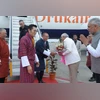
King of Bhutan Jigme Khesar Namgyel Wangchuck along with Prime Minister Tshering Tobgay being welcomed by Gujarat Chief Minister Bhupendra Patel, at Ahmedabad airport. (PTI Photo)
3 min read Last Updated : Dec 04 2024 | 7:25 PM IST
Bhutan King Jigme Khesar Namgyel Wangchuck will pay a two-day visit to India beginning Thursday to further advance the already close bilateral partnership between the two nations.
Wangchuck will be accompanied by Queen Jetsun Pema Wangchuck and senior officials of the Bhutanese government, the Ministry of External Affairs (MEA) said, announcing the trip.
The King will meet Prime Minister Narendra Modi and the two leaders are expected to deliberate on ways to further deepen bilateral cooperation in a wide range of areas.
"India and Bhutan enjoy unique ties of friendship and cooperation, which are characterised by mutual understanding and trust," the MEA said.
"The visit shall provide both sides an opportunity to review the entire gamut of bilateral cooperation and to further advance the exemplary bilateral partnership across diverse sectors," it said in a statement.
External Affairs Minister S Jaishankar and other senior officials of the government will also call on the King, it said.
Bhutanese Prime Minister Tshering Tobgay visited India around 10 days ago.
The King's visit to New Delhi comes amid China's efforts to establish formal diplomatic relations with Bhutan.
The two sides are also looking at an expeditious resolution of their festering boundary row that could have implications for India's security interests.
Over a year ago, Bhutan's then Foreign Minister Tandi Dorji held talks with his Chinese counterpart Wang Yi in Beijing.
A Chinese readout on the talks said Bhutan firmly abides by the one-China principle and stands ready to work with China for an early settlement of the boundary issue.
New Delhi has been keeping a close eye on the negotiations between Bhutan and China on their boundary row as it could have implications for New Delhi's security interests, especially in the Doklam tri-junction.
In August last year, China and Bhutan agreed to expedite and take simultaneous steps to implement a "three-step roadmap to resolve their festering boundary dispute.
In October 2021, Bhutan and China signed an agreement on the "three-step roadmap" to expedite negotiations to resolve their boundary dispute.
The signing of the pact came four years after the Indian and Chinese armies were locked in a 73-day stand-off at the Doklam tri-junction after China tried to extend a road in the area that Bhutan claimed belonged to it.
The India-China stand-off in the Doklam plateau in 2017 even triggered fears of larger conflict between the two neighbours. Bhutan had said the area belonged to it and India supported the Bhutanese claim.


 "Bhutan king Wangchuck to visit India for two-day trip starting Thursday")

