The Indian Navy has shelved its plans to operate three aircraft carriers simultaneously and is instead prioritising the development of a second indigenous aircraft carrier (IAC) as a future replacement for INS Vikramaditya, ThePrint reported on Monday. The report stated that the government does not support the Navy’s stance on maintaining a fleet of three aircraft carriers, which would have ensured that at least two remain operational at all times, even when one undergoes refits.
This development follows reports from late last year suggesting that China is advancing its nuclear-powered aircraft carrier programme, with indications that its fourth carrier could feature nuclear propulsion.
According to ThePrint, the Navy’s decision follows a shift in its naval policy, which had originally aimed to establish a three-carrier force. Multiple naval chiefs in the past, including the immediate predecessor of the current naval chief, Admiral Hari Kumar, had advocated for the addition of a third aircraft carrier.
However, reports suggest that the government has opposed the Navy’s stance since at least 2020, advocating instead for a greater emphasis on submarines rather than aircraft carriers. Former Chief of Defence Staff General Bipin Rawat had publicly expressed scepticism about the necessity of a three-carrier fleet, referring to them as "sitting ducks".
Former Navy Chief Admiral Hari Kumar had reportedly proposed placing a repeat order for INS Vikrant, a 45,000-tonne aircraft carrier. However, previous naval chiefs had advocated for a larger carrier capable of accommodating more fighter jets, arguing that such a platform would offer greater operational advantages in warfare compared to a carrier with a limited aircraft complement.
Sources within the defence establishment told ThePrint that INS Vikramaditya, a refurbished Russian aircraft carrier, will need to be phased out within the next 10–12 years.
Building an aircraft carrier requires approximately 10 to 12 years from the approval stage. According to the sources, many within the Indian Navy believe that the second indigenous aircraft carrier should be viewed as a replacement for Vikramaditya, rather than as an additional carrier.
In May 2024, Defence Minister Rajnath Singh reportedly announced that India would soon commence construction of its third aircraft carrier, which is expected to replace INS Vikramaditya, as indicated in ThePrint report. Singh had made these remarks in the context of the Navy’s pending proposal to build another indigenous aircraft carrier of similar size to INS Vikrant, a 45,000-tonne warship commissioned in September 2022.
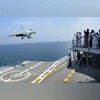
Currently, the Indian Navy operates two 45,000-tonne aircraft carriers: INS Vikramaditya and INS Vikrant. Both carriers are conventionally powered and utilise ski-jump ramps for aircraft take-offs. INS Vikrant, India's first indigenous carrier, was built by Cochin Shipyard Ltd, while INS Vikramaditya, originally from Russia, has been in service since 2014.
Each carrier can accommodate 25-30 fixed-wing aircraft along with 10 helicopters. If the proposed third aircraft carrier is of the same size and features conventional propulsion like INS Vikrant, it is expected to have a similar air wing capacity.
However, a project study initiated during former Defence Minister Manohar Parrikar’s tenure envisioned the second indigenous aircraft carrier as a 65,000-tonne CATOBAR (Catapult Assisted Take-Off Barrier Arrested Recovery) warship with electric propulsion. The proposed carrier was designed to accommodate a 54-fighter air wing, with considerations reportedly given to nuclear propulsion and electromagnetic catapults. However, current plans indicate that the second indigenous carrier, and India’s third overall, will be conventionally powered.
What’s Behind the Decision to Drop a Three-Carrier Fleet?
Rather than expanding the aircraft carrier fleet, the government reportedly prioritises sea denial capabilities through submarines. Aircraft carriers are seen as capital-intensive assets, not only due to their own costs but also because of the expenses associated with the Carrier Battle Group and fighter aircraft. Additionally, China has developed long-range anti-ship ballistic missiles designed to target aircraft carriers, specifically those of the United States, which are significantly larger and more heavily defended than their Indian counterparts.
The government has already revised the 30-year submarine-building programme. Instead of the originally planned 24 conventional submarines, the sanctioned fleet now consists of 18 diesel-electric submarines and six nuclear-powered attack submarines (SSNs), in addition to the ongoing nuclear ballistic missile submarine (SSBN) programme.
What Do We Know About China's Nuclear-Powered Carrier Plans?
In November 2024, reports suggested that China is advancing its nuclear-powered aircraft carrier plans. Among these, the South China Morning Post highlighted renewed interest in Beijing’s global naval ambitions, citing reports of a prototype nuclear reactor under development.
Unlike conventional carriers, nuclear-powered aircraft carriers can operate for extended durations without refuelling, granting them greater operational range and the ability to carry more fuel and weapons for their aircraft.
China’s pursuit of a nuclear-powered carrier has long been speculated upon, with analysts viewing it as a crucial step in the People’s Liberation Army (PLA) Navy’s quest for blue-water capabilities. The PLA Navy, already the world’s largest, aims to operate six aircraft carriers by 2035 as part of its modernisation drive.
Its most recent and third aircraft carrier, the Fujian, began sea trials in 2024 and is the first non-US carrier to feature an electromagnetic catapult launch system, allowing for higher-frequency aircraft launches.
The Fujian’s successor, tentatively referred to as Type 004, is expected to be of similar or larger size. If the nuclear reactor project proves successful, future Chinese aircraft carriers are expected to be entirely nuclear-powered.
In March 2024, the political commissar of the PLA Navy confirmed that work on a fourth aircraft carrier was underway, with an announcement regarding its potential nuclear propulsion expected soon.
The United States (US) currently operates 11 nuclear-powered aircraft carriers, while France has a single nuclear-powered carrier, the Charles de Gaulle. All of China’s existing carriers are conventionally powered, though the Fujian is larger and more advanced than its Chinese predecessors and Indian counterparts.

 "India decides it will not operate a third aircraft carrier. Here is why")


 Connect with us on WhatsApp