3 min read Last Updated : Mar 12 2024 | 12:23 AM IST
In a major technological leap for India’s nuclear deterrent, the Defence Research and Development Organisation (DRDO) conducted India’s first successful flight test of the indigenously developed Agni-V missile. The test involved the missile carrying between four to six dummy warheads.
The flight test, named Mission Divyastra, was carried out from Dr APJ Abdul Kalam Island off the Odisha coast.
Ever since the Agni-V intermediate-range ballistic missile (IRBM) was first tested to its full 5,000-kilometre range on 19 April 2012, analysts worldwide have speculated about when India would test its successor – presumptively India’s first intercontinental ballistic missile (ICBM) and whether it would be tipped with multiple warheads.
The Agni-series missile, which was successfully tested on Monday, may not have been fired to its maximum range of 5,000 km. Instead, the emphasis of the test was on firing multiple warheads to strike widely-separated targets.
Prime Minister Narendra Modi lauded the DRDO scientists who participated in the complex mission. Posting on social media platform X, Modi said, “Proud of our DRDO scientists for Mission Divyastra, the first flight test of indigenously developed Agni-V missile with Multiple Independently Targetable Re-entry Vehicle (MIRV) technology.”
MIRV technology
The technology that goes into putting multiple warheads on a single rocket or missile is known as “multiple independently targetable re-entry vehicle” (MIRV) technology. As its name suggests, it involves launching a single missile carrying 4-6 warheads, each of which can be programmed to strike a separate target, several hundred kilometres apart.
MIRV technology was being perfected and tested on workhorse rockets of the Indian Space Research Organisation (Isro) in their commercial launches which were geared towards launching a single rocket that placed several satellites in orbit.
Launching a MIRV-tipped missile – say an Agni-IV or Agni-V – offers several tactical and strategic advantages. It provides more target options to the attacker. Meanwhile, the defender is forced to defend all of them simultaneously, with its anti-missile defences possibly being overwhelmed.
Even without a sanctioned government project for testing MIRV technology, it seemed inevitable that the Agni-V would organically evolve into an ICBM with reduced weight and improved technologies and capabilities.
Chinese officials have always regarded the Agni-V as an ICBM, with some even stating it is capable of striking targets 8,000 km away.
Greater operational range
One key aspect in extending the range of the 50-tonne Agni-V missile is the reduction of its weight. This involves replacing older, heavier sub-systems with lighter, more reliable ones, including components made with lightweight composite materials. A notable development in this regard is the replacement of hydraulic actuators in the Agni-V’s giant first stage with the state-of-the-art, electro-mechanical actuators that already equip Stage-2 and Stage-3.
Moving from hydraulic to electro-mechanical actuators not only saves weight due to lightweight components but also eliminates problems like oil storage and leakage, and the need for an accumulator. In addition, electro-mechanical actuators are more reliable and easy to maintain.
Currently, the Agni-V has a metallic first stage, made of ‘maraging steel’, while the second and third stages are entirely built from lightweight composites, which were first tested in the Agni-IV on 15 November 2011. Stage-1 components like high-temperature rocket motor nozzles are already being made of composites. Gradually, the Agni-V could become an all-composite missile that is significantly lighter than at present.

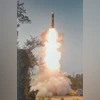 "Mission Divyastra: India's Agni-V missile makes maiden flight with MIRV")


