Delhi's fuel ban on 15-yr-old vehicles: Experts back EVs, public transport

In addition to restricting fuel supply, all high-rise buildings, hotels, and commercial complexes in Delhi will be required to install anti-smog guns to help reduce air pollution levels

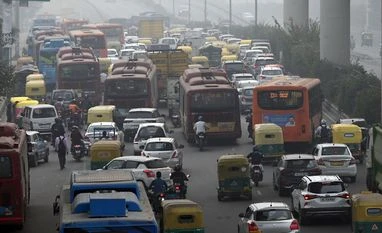
New Delhi, India, air pollution
Photo: Bloomberg
Puja Das New Delhi
5 min read Last Updated : Mar 02 2025 | 10:55 PM IST
To combat air pollution in Delhi, experts suggest that the government should scale up electrification, enhance public transport, and implement better vehicle assessment systems rather than imposing a blanket ban on older vehicles.
 
This follows the Delhi government’s announcement on Saturday that vehicles older than 15 years will be denied fuel at petrol pumps starting April 1. Announcing various anti-pollution measures, Delhi Environment Minister Manjinder Singh Sirsa said the newly formed Bharatiya Janata Party government is taking stringent steps to curb vehicular emissions and pollution.
 
“We are installing automatic number plate readers (ANPRs) at petrol pumps to identify vehicles older than 15 years, and they will not be provided fuel. Around 80 per cent of petrol pumps have already adopted ANPRs,” said Sirsa, adding that the Union Ministry of Petroleum and Natural Gas will be informed about this decision.
 
The government has also said all high-rise buildings, hotels, and commercial complexes in Delhi will be required to install anti-smog guns to help reduce pollution levels.
 
“Eliminating vehicles based solely on age is just the first phase. The government should develop a more effective on-road emissions monitoring system using remote sensing technologies and advanced fitness tests. This would help identify end-of-life (EoL) or unfit vehicles more efficiently rather than imposing a blanket ban,” said Anumita Roychowdhury, executive director of Research and Advocacy at the Centre for Science and Environment (CSE).
 
“The main challenge is the lack of a reliable system to effectively identify unfit vehicles. Unlike commercial vehicles, personal vehicles do not undergo regular roadworthiness tests, which only occur after 15 years. The absence of proper testing has forced the government to use an age-based cutoff,” Roychowdhury said.
 
The directive to phase out 10-year-old diesel vehicles and 15-year-old petrol vehicles stems from a National Green Tribunal (NGT) order upheld by the Supreme Court. The Delhi government has already deregistered these vehicles.
 
Experts said that denying fuel to older vehicles is a policy, focused on enforcement, which has been difficult as many owners wish to keep their vehicles.
 
“Fleet renewal is a critical strategy for reducing emissions, as older vehicles emit significantly more pollutants than newer models. It would be even more effective to incentivise their replacement with zero-emission electric vehicles,” Roychowdhury said.
 
Severe air pollution in Delhi-NCR remains a major issue. On December 16, 2024, Stage 4 of the Graded Response Action Plan (GRAP), the strictest level of anti-pollution measures, was enforced as the air quality index (AQI) exceeded 400, indicating “severe” conditions. This marked the second instance in the last winter, with the first triggered on November 18 due to stubble burning, which pushed AQI to 494.
 
A study by CSE conducted last year found that during mid-October to early November — when farmers burn paddy stalks — only 8 per cent of Delhi-NCR’s air pollution came from stubble burning, while nearly two-thirds originated from local sources, with the transport sector contributing more than half.
 
According to the International Energy Agency, road transport accounts for 12 per cent of India’s energy-related CO2 emissions and is a major contributor to urban pollution. As demand for private transportation and goods movement grows, energy use and CO2 emissions from road transport could double by 2050.
 
Newer BS6 vehicles produce significantly lower emissions than older BS2, BS3, and BS4 models. Compared to BS4 vehicles, BS6 models emit around 70 per cent less nitrogen oxides (NOx) in diesel engines and 25 per cent less NOx in petrol engines, along with a considerable reduction in particulate matter (PM).
 
“Beyond petrol pumps, ANPRs could be deployed at city entry points and key road sections to identify and penalise non-compliant vehicles. However, many of these vehicles migrate to other cities without such restrictions, which allows them to continue polluting elsewhere,” said Karthik Ganesan, Fellow and Director of Strategic Partnerships at the Council on Energy, Environment, and Water (CEEW).
 
Ganesan said a well-implemented vehicle scrappage system is essential to ensure proper disposal. Currently, there are incentives on motor vehicle tax for those scrapping old vehicles and purchasing new ones. However, many vehicles are resold and registered in other jurisdictions, which could deter the scrapping process.
 
Both Roychowdhury and Ganesan agreed that the Delhi government must introduce better fiscal and non-fiscal incentives to encourage zero-emission vehicle adoption. Uniform implementation of the scrappage policy across states is crucial to effectively remove EoL and unfit vehicles, they said. “While enforcing these measures, it is crucial to accelerate electrification and modernise public transport to reduce reliance on private vehicles,” Roychowdhury said.
 
Last December, Delhi was the only major state or Union Territory to record a major decline in electric vehicle (EV) registrations, even though the government extended its EV policy until March 2025.
 
“More action is needed in the transport sector. At the same time, Delhi must do much more to eliminate waste burning. This requires municipalities to ensure proper waste collection, segregation, and recovery to prevent open dumping and burning,” she added.
 
According to environment and climate expert Asutosh Acharya, “For the entire city, each sector and each area has different peak hours for air pollution. To understand the pollution and related exposure, we have to have a detailed analysis of how the localised peak hours vary and what kind of vehicles are contributing to localised air pollution. That can be achieved by leveraging technology.”
 
and establishing city-specific hyperlocal air pollution monitoring networks. Then, an area specific policies should be implemented for better results and effective intervention strategy.”
 
Other experts recommend conducting a detailed study to assess vehicle emissions, interstate pollution control, and strategies to manage vehicular movements effectively.

One subscription. Two world-class reads.

Already subscribed? Log in

Subscribe to read the full story →
*Subscribe to Business Standard digital and get complimentary access to The New York Times

Smart Quarterly

₹900

3 Months

₹300/Month

SAVE 25%

Smart Essential

₹2,700

1 Year

₹225/Month

SAVE 46%
*Complimentary New York Times access for the 2nd year will be given after 12 months

Super Saver

₹3,900

2 Years

₹162/Month

Subscribe

Renews automatically, cancel anytime

Here’s what’s included in our digital subscription plans

Exclusive premium stories online

  • Over 30 premium stories daily, handpicked by our editors

Complimentary Access to The New York Times

  • News, Games, Cooking, Audio, Wirecutter & The Athletic

Business Standard Epaper

  • Digital replica of our daily newspaper — with options to read, save, and share

Curated Newsletters

  • Insights on markets, finance, politics, tech, and more delivered to your inbox

Market Analysis & Investment Insights

  • In-depth market analysis & insights with access to The Smart Investor

Archives

  • Repository of articles and publications dating back to 1997

Ad-free Reading

  • Uninterrupted reading experience with no advertisements

Seamless Access Across All Devices

  • Access Business Standard across devices — mobile, tablet, or PC, via web or app

Topics :air pollutionPetrol pumpair pollution in IndiaDelhi Pollution

Next Story