
Fertiliser subsidy bill to fall up to 34 % to Rs 1.8 trillion this fiscal
'Ministry of External Affairs is making necessary interventions and our Navy is giving protection to Indian cargo vessels,' Mandaviya told reporters
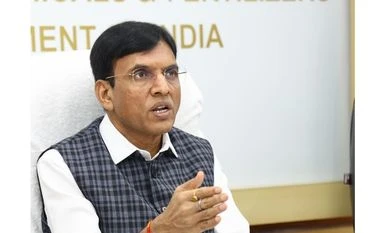 "Fertiliser subsidy bill to fall up to 34 % to Rs 1.8 trillion this fiscal")
Explore Business Standard

Associate Sponsors
Co-sponsor
'Ministry of External Affairs is making necessary interventions and our Navy is giving protection to Indian cargo vessels,' Mandaviya told reporters
The government's fertiliser subsidy bill is likely to decline 30-34 per cent to Rs 1.7-1.8 lakh crore this fiscal due to fall in global prices and lower imports of urea, Union Minister Mansukh Mandaviya said on Wednesday.
Asked about any adverse impact on imports due to problems in Red sea, the minister asserted "there is no shortage of fertilisers in the country".
Addressing a press conference, chemicals and fertilizers minister Mansukh Mandaviya highlighted that the urea imports are estimated at 40-50 lakh tonnes this fiscal, lower from around 75 lakh tonnes imported in the previous year, helped by higher domestic production and increased use of nano liquid urea.
"Ministry of External Affairs is making necessary interventions and our Navy is giving protection to Indian cargo vessels," Mandaviya told reporters.
According to exporters, freight rates have skyrocketed by up to 600 per cent due to the Red Sea crisis which would hurt the world trade.
The geopolitical tension around the Bab-el-Mandeb Strait, a crucial shipping route connecting the Red Sea and the Mediterranean Sea to the Indian Ocean, has escalated due to recent attacks by Yemen-based Houthi militants.
The minister also spoke about his new book 'FERTILISING THE FUTURE: Bharat's March Towards Fertiliser Self-Sufficiency'.
Mandaviya said there is sufficient availability of fertilisers in the country to meet the requirements of the kharif (summer sown) season.
At present, the country has stocks of 70 lakh tonnes of urea, 20 lakh tonnes of DAP, 10 lakh tonnes of MoP (Muriate of Potash), 40 lakh tonnes of NPK and 20 lakh tonnes of SSP (single super phosphate).
Mandaviya highlighted that the government has taken several steps since 2014 to boost domestic production of fertilisers and reduce import dependence.
He said four urea plants have already been revived and the fifth one would also start production soon.
The minister said the Centre is also promoting alternate fertilisers line -- nano liquid urea and nano liquid DAP. Besides, it has launched a scheme to incentivise states that curb use of chemical fertilisers.
India has entered into long-term supply agreements with global suppliers for assured imports of fertilisers and its raw materials at pre-determined prices, he added.
Asked about fertiliser subsidy, Mandaviya said the subsidy bill is estimated at around Rs 1.7-1.8 lakh crore.
"Subsidy is expected to be lower this year because of fall in global prices. We have not increased retail prices to reduce subsidy," he said.
When the global rates skyrocketed during last fiscal, he said, the government increased subsidy and kept the retail prices of urea, di ammonium phosphate (DAP) and other fertilisers to protect farmers interest.
(Only the headline and picture of this report may have been reworked by the Business Standard staff; the rest of the content is auto-generated from a syndicated feed.)
First Published: Jan 17 2024 | 5:47 PM IST

