Prime Minister Narendra Modi and French President Emmanuel Macron have called for the early finalisation of the Defence Industrial Road Map. Both leaders had a lunch meeting here after the conclusion of the Group of Twenty (G20) Summit.
“Both leaders reiterated their commitment to strengthen defence cooperation through a partnership in the design, development, testing, and manufacture of advanced defence technologies and platforms and to expand production in India, including for third countries in the Indo-Pacific and beyond,” the India-France joint statement said.
Regarding nuclear cooperation, the statement noted good progress in the discussion for the Jaitapur nuclear plant project. It said both sides will continue engagements to establish a partnership for co-developing small modular reactor (SMR) and advanced modular reactor (AMR) technologies.
SMR nuclear reactors are generally 300 megawatt equivalent or less, designed with modular technology using module factory fabrication, pursuing economies of series production, and short construction times.
India and France are also engaged in signing a dedicated declaration of intent. “
“France reiterated its steadfast and unwavering support for India’s membership in the Nuclear Suppliers Group,” the statement said.
The talks also saw discussions on the next steps needed for the implementation of new cooperation goals in areas of defence, space, nuclear energy, digital public infrastructure, critical technology, and climate change.
The talks took into account progress on the ‘Horizon 2047’ road map announced by both countries, which was announced to mark 50 years of strategic partnership. Both sides also agreed to work together on the development of museums.
India’s partnership with France in the Indo-Pacific region heavily figured in the discussions. The Indo-Pacific Road Map announced in July during Modi’s visit to France was also reviewed.
Both sides underlined their role as providers of solutions for the Indo-Pacific through their cooperation in the framework of the International Solar Alliance, launched by India and France, and the Coalition for Disaster Resilient Infrastructure.
The model of the Indo-French Campus for the Indo-Pacific was discussed as one that could be replicated for other institutional linkages in areas such as digital, science, technological innovation, education, culture, health, and environmental cooperation.
They also carried forward their discussions on Africa, including infrastructure, connectivity, energy, biodiversity, sustainability, and industrial projects.
Reforming the United Nations (UN) with Brazil
Modi also had a meeting with Luiz Inácio Lula da Silva, President of Brazil and the new G20 Chair, focusing on the need to reform the UN Security Council (UNSC). Both leaders reaffirmed their commitment to reforming the Council to include more permanent and non-permanent nations and increase the representation of developing countries.
The joint statement released after the meeting announced both nations will have regular bilateral coordination meetings going forward on UNSC reform.
“The two leaders expressed disappointment at the paralysis created at the Intergovernmental Negotiations on UNSC Reform, which have not produced tangible progress. They agreed that the time has come to move towards a result-oriented process that aims to achieve concrete outcomes in a fixed time frame,” the statement said.
Modi welcomed Brazil’s support for India’s candidature for a non-permanent seat on the UNSC for the 2028–2029 term.
The leaders also noted the conclusion of domestic procedures for the entry into force of the India-Brazil Social Security Agreement.
Bilaterals galore
Modi also had a series of separate bilaterals with the leaders of Canada, Germany, Turkey, South Korea, the Netherlands, Nigeria, the Comoros, and the Presidents of the European Council and European Commission.
In his meeting with Canadian Prime Minister Justin Trudeau, Modi conveyed India’s strong concerns about continuing ‘anti-India activities of extremist elements in Canada’, referring to Khalistani activities.
“They are promoting secessionism and inciting violence against Indian diplomats, damaging diplomatic premises, and threatening the Indian community in Canada and their places of worship. The nexus of such forces with organised crime, drug syndicates, and human trafficking should be a concern for Canada as well,” the Ministry of External Affairs said in a release afterwards.
There are upwards of 1.85 million people of Indian origin in Canada, of whom 34 per cent are Sikh, according to Canadian official statistics.
Modi’s meeting with European Council President Charles Michel and European Commission President Ursula von der Leyen focused on the India-European Union (EU) Strategic Partnership, including the next India-EU Summit.
Ongoing Free Trade Agreement negotiations, climate change, digital technology, and the Trade and Technology Council (TTC) also figured in the talks.
The leaders stressed that the India-Middle East-Europe Economic Corridor that was launched on Saturday should be expeditiously implemented. The Prime Minister also highlighted the possibilities of solar projects under the corridor.
Turkish President Recep Tayyip Erdogan thanked India for the prompt relief under Operation Dost after the earthquake in Turkiye in February 2023. Discussions between the two leaders also included bilateral ties with potential in areas like trade and investment, defence and security, civil aviation, and shipping.
Modi's meeting with South Korea President Yoon Suk Yeol reviewed progress on various areas of bilateral special strategic partnership, including trade and investment, defense production, semiconductors, and electric vehicle battery technology. Year 2023 marks the 50th anniversary of diplomatic ties being established.

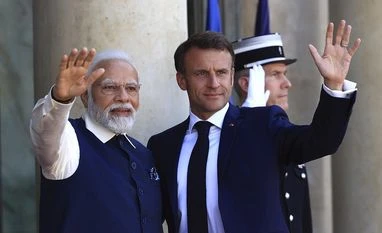 "G20 Summit 2023: PM Modi, Macron talk defence, nukes, space, and climate")


