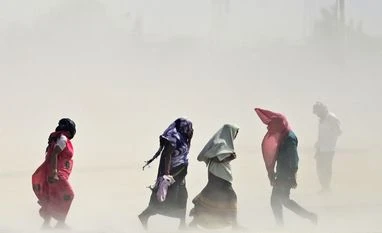
The intensity and frequency of heat waves are going to increase in the future due to climate change and governments need to act now to prevent worse impacts on public health and food security, experts said on Thursday.
A new study by researchers from the University of Cambridge on Wednesday said the entire Delhi is vulnerable to severe impacts of heat waves, though its recent state action plan for climate change does not reflect this.
The study, published in the peer-reviewed journal PLOS Climate, suggested that heat waves have impeded India's progress towards achieving the United Nations' Sustainable Development Goals more significantly than previously thought and that the current assessment metrics may not fully capture the impacts of heat waves linked to climate change on the country.
Heat waves claimed more than 17,000 lives in 50 years in India, according to a paper authored by M Rajeevan, former secretary of the Union Ministry of Earth Sciences, along with scientists Kamaljit Ray, S S Ray, R K Giri and A P Dimri.
The paper, published in 2021, said there were 706 heatwave incidents in the country from 1971-2019.
Thirteen people died from heatstroke at a Maharashtra government award programme in Navi Mumbai on Sunday, making it one of the highest death tolls from a single heatwave-related event in the country's history.
Mahesh Palawat, vice president of meteorology and climate change at Skymet Weather, said, "The frequency and intensity of heat waves are going to increase due to climate change. In places like Delhi, green cover is getting depleted due to large-scale development. Concrete jungles have come up in place of forests in Delhi-NCR, resulting in more heat islands. The government should focus on maintaining a balance."
Factors that will aggravate heat-related vulnerabilities include the concentration of slum population and overcrowding in high Heat Index areas, lack of access to basic amenities such as electricity, water and sanitation, non-availability of immediate healthcare and health insurance, poor condition of housing and dirty cooking fuel.
Prof Anjal Prakash of the Bharti Institute of Public Policy at the Indian School of Business said climate change-induced heat waves in India present a significant threat to the country's sustainable development goals, hindering progress in public health, agriculture and socio-economic systems.
He said the reliance of governments on the Climate Vulnerability Index underestimates the impact of heat waves on developmental efforts.
Combining the Heat Index with Climate Vulnerability Index can identify practical climate vulnerability impacts that account for extreme weather events at the state level, aiding in a better understanding of India's Sustainable Development Goals progress, Prakash said.
Rajeevan, the former Ministry of Earth Sciences secretary, agreed with the study and said that the Climate Vulnerability Index indeed has some loopholes. That needs to be taken care of.
He added that the Indian Meteorological Department should switch over to Heat Index at the earliest.
"Heat Index is not just based on temperature, it also involves humidity. For example, the temperature may not go above 40 (degrees Celsius) but if there's high humidity it can affect people's health. It is high time India started using this type of indices," the senior meteorologist said.
Earlier this month, the India Meteorological Department predicted above-normal maximum temperatures from April to June for most parts of the country, except parts of the northwest and the peninsular regions.
Above-normal heatwave days are expected in most parts of central, east, and northwest India during this period.
In 2023, India experienced its hottest February since record-keeping began in 1901. However, above-normal rainfall in March kept temperatures in check.
March 2022 was the warmest ever and the third driest in 121 years. The year also saw the country's third-warmest April since 1901.
In India, about 75 per cent of workers (around 380 million people) experience heat-related stress.
A report by the McKinsey Global Institute warns that if this continues, by 2030, the country could lose between 2.5 to 4.5 per cent of its Gross Domestic Product per year.


 "Intensity, frequency of heat waves to rise due to climate change: Experts")

