Home / India News / June setback shouldn't dampen monsoon from performing well: Meteorologists
June setback shouldn't dampen monsoon from performing well: Meteorologists
Even the IMD in its latest forecast predicted a revival of the rains over eastern India and gradual abatement of the heatwave conditions over North India
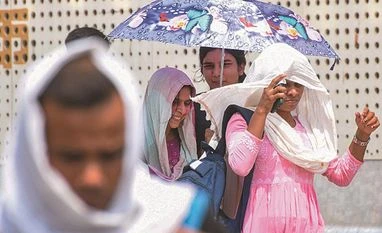
Delhi on Wednesday recorded minimum temperature at 35.2 degree Celsius (°C), its highest in June in almost 55 years
The India Meteorological Department’s (IMD’s) revised monsoon forecast for June to “below normal” from the previous prediction of “normal” rainfall will not impact the overall performance of this year’s monsoon, which is still expected to be “above normal” at almost 106 per cent of the Long Period Average (LPA), senior meteorologists and weathermen said on Wednesday.
The response comes a day after the IMD, in a mid-course correction, downgraded its June rainfall prediction for the country to “below normal”. It scaled down its monsoon forecast as the rains, after making a steady run since arriving over the Kerala coast on May 30, virtually stopped in the last few days due to the cessation of cyclonic activities over Southern India. The Eastern arm of the Southwest monsoon also became less active in the last few days, resulting in the widening of the cumulative rainfall deficit to almost 20 per cent across the country as of June 18.
Allaying fears of low rainfall, senior meteorologists said the rain is poised for a strong revival in the next few days and might even reach North-West India by the end of June, asserting that all other factors that were in favor of the southwest monsoon in April still stand.
“In many years in the past too, monsoon has been deficient in June while by the time the season ended, there was excess rainfall. June is not a very important month from the point of southwest monsoon season. The current scale down is mainly because the rainfall has stalled which will make it difficult to wipe off the shortfall even if it revives very strongly in the last week of June,” Madhavan Rajeevan, a former secretary of the Ministry of Earth Sciences and a renowned Indian monsoon expert, told Business Standard.
Despite the June setback, all the factors that were relevant in April when the first 2024 monsoon forecast was made still hold, which includes the emergence of La Nina during the second half of the four-month season and a positive Indian Ocean Dipole (IOD).
June with 16.6 centimeters of rainfall gets 19.1 per cent of the total national cumulative monsoon rainfall for the four months (June, July, August, and September) estimated at 87 centimeters.
“The monsoon rains will pick up very strongly in the next few days and will cover the whole of Madhya Pradesh and Eastern India and might even reach North India by 27-28 June. Therefore, the current deficit will start coming down sooner than later, and this setback won’t impact the overall performance of the monsoon,” Mahesh Palawat, said Vice President of Meteorology and Climate Change at private weather forecasting agency Skymet Weather.
Even the IMD in its latest forecast predicted a revival of the rains over Eastern India and gradual abatement of the heatwave conditions over North India.
A strong revival of southwest monsoon and its good performance thereafter mainly over the rain-fed areas are imperative to boost agriculture growth which has slumped to a five-year low of just 1.4 per cent in the last financial year (FY24) due to below-par monsoon in 2023. That apart, the monsoon will fill up the reservoirs which have gone dry in several states, thus impacting the sowing of rabi crops.
In its second stage forecast released in late May, the IMD, while reiterating its ‘above normal’ forecast for the 2024 monsoon season, also noted that the rain-fed areas of the country might get copious ‘above normal’ rainfall.
Delhi records minimum temperature at 35.2°C, highest in almost 55 years
Delhi on Wednesday recorded minimum temperature at 35.2 degree Celsius (°C), its highest in June in almost 55 years. The temperature was recorded at the Safdarjung observatory. “This conundrum of extreme heat and monsoon variability is due to climate change and El Niño impacts. Boiling summers are the new normal. We need year-round preparedness to be more proactive than reactive in dealing with heatwaves,” said Vishwas Chitale, senior programme lead, Council on Energy, Environment and Water. The previous highest minimum temperature for June was 34.7 °C recorded on June 3, 2010. “As we endure this intense heatwave, it is critical to follow the recommended dos and don’ts and take appropriate actions,” he said.

 "June setback shouldn't dampen monsoon from performing well: Meteorologists")


 Connect with us on WhatsApp