Tamil Nadu is once again at odds with the BJP-led Union government over the alleged imposition of Hindi, a contentious issue in south India.
The Dravida Munnetra Kazhagam (DMK)-led Tamil Nadu government has accused the Centre of withholding ₹2,000 crore after rejecting the National Education Policy’s (NEP) three-language formula, which mandates that students learn their regional language (mother tongue), Hindi, and English.
Tamil Nadu Chief Minister MK Stalin and other south Indian leaders, including Karnataka Chief Minister Siddaramaiah, continue to oppose Hindi promotion in education, railway exams, postal services, and other national-level recruitments.
Political opposition to Hindi imposition
Stepping up his attack against Hindi imposition, Stalin stated in a social media post:
“Some entitled bigots brand us chauvinists and anti-nationals for the ‘crime’ of demanding Tamil’s rightful place in Tamil Nadu. Demanding linguistic equality is not chauvinism.”
He also claimed that many north Indian languages, including Maithili, Brajbhasha, Bundelkhandi, and Awadhi, have been “destroyed by the hegemonic Hindi.”
Opposition to Hindi imposition is not limited to the DMK. The All India Anna Dravida Munnetra Kazhagam (AIADMK) has also consistently opposed it despite its alliance with the BJP. For decades, Tamil Nadu has resisted making Hindi a compulsory language in schools, with protesters arguing that the fight is about preserving Tamil identity.
Here’s a look at Tamil Nadu’s historical resistance to Hindi imposition, dating back to British India:
History of anti-Hindi protests
In August 1937, C Rajagopalachari, then chief minister of the Madras Presidency (which covered present-day Tamil Nadu, Andhra Pradesh, parts of Karnataka, and Kerala), announced the introduction of Hindi in secondary schools. In April 1938, he issued a government order making Hindi compulsory in 125 schools. This triggered massive anti-Hindi agitations (1937–1940), led by EV Ramasamy (Periyar) and the Justice Party (South Indian Liberal Federation). The protests led to arrests and deaths of agitators like Thalamuthu and Natarajan, forcing the British government to withdraw the Hindi policy in 1940.
After independence, the Constitution of India (1950) declared Hindi as the official language, with English as a temporary associate language until 1965. The government intended to make Hindi the sole official language by 1965, replacing English. This sparked massive protests in Tamil Nadu, led by CN Annadurai, founder of the DMK. The 1965 anti-Hindi agitation turned violent, with students self-immolating and large-scale demonstrations. As a result, Prime Minister Lal Bahadur Shastri allowed English to continue indefinitely as an associate official language.
Tamil Nadu’s ongoing opposition
When the DMK came to power in Tamil Nadu in 1967, led by CN Annadurai, the state officially adopted a two-language policy (Tamil and English), rejecting the three-language formula followed in other states. Since then, every government in Tamil Nadu has opposed Hindi imposition, making it the only Indian state where Hindi is not compulsory in schools.
In the 1990s, protests erupted again when the Centre’s exams and recruitments were seen as favouring Hindi speakers. In 2014, the NDA government, led by Narendra Modi, pushed for greater use of Hindi in official communications, triggering criticism. In 2017, the Tamil Nadu government strongly opposed making NEET (National Eligibility cum Entrance Test) Hindi-biased, arguing that it disadvantaged non-Hindi-speaking students.
Home Minister Amit Shah’s repeated calls for making Hindi a “link language” led to backlash in Tamil Nadu, Karnataka, and Kerala in 2019 and again in 2022.
Concerns beyond language
Beyond the Hindi imposition debate, southern states have also raised concerns over their shrinking share of central tax devolution, which exacerbates regional disparities.
With tensions escalating, Tamil Nadu’s resistance to Hindi imposition remains a defining issue in its socio-political landscape.

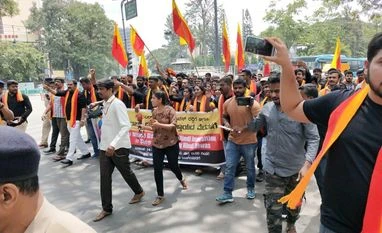 "Periyar to Stalin: A look at Tamil Nadu's unyielding battle against Hindi")

