Associate Sponsors

PM-KUSUM: Baton handed to states to customise agriculture-solar goals

Scheme likely to go off-Budget as targets linked to discom reforms
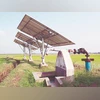
Solar, renewable, green, power, energy, solar-powered pumps
Shreya Jai New Delhi
5 min read Last Updated : Dec 19 2023 | 11:04 PM IST
The flagship scheme of the Centre for the solarisation of the agriculture (agri) sector, launched in 2018, would now be passed on to states to customise and offer it according to their needs. The progress of the Rs 1.4 trillion Pradhan Mantri Kisan Urja Suraksha evam Utthaan Mahabhiyan Yojana (PM-KUSUM) scheme has been marred by the pandemic, lack of required funds, and awareness. The scheme is unlikely to get a budgetary grant this year, sources indicated.

The scheme’s acceptance among farmers was also impacted by several phony agencies fleecing farmers with counterfeit schemes and bogus websites.

Until November 2023, under Component A, which aimed at installing solar power units on farmlands, against a sanctioned capacity of 4.7 gigawatt (Gw), 0.14 Gw has been achieved.

Under Component B, which is for installing standalone solar-run irrigation pumps, 272,000 pumps have been installed as against the target of 946,000.

Component C, which is for the solarisation of grid-connected agri pumps, of 122,930 sanctioned pumps, 1,894 have been solarised, and of 2.9 million feeder-level solar, 4,572 have been installed.

According to the scheme guidelines, it aims to add a solar capacity of 30 Gw by 2022 with a total central financial support of Rs 34,422 crore, including service charges to the implementing agencies.

For the three components, the target is to have 10 Gw of solar capacity under Component A, 2 million standalone solar-powered agri pumps under Component B, and solarisation of 1.5 million grid-connected agri pumps until 2026.

Sources said the Centre is of the view that the PM-KUSUM scheme has created a format, a standard bidding document, and benchmark pricing for states to follow.

“The Centre’s initial support has shown the way to states. Most states have their KUSUM-like schemes and have been asking the Centre that the scheme needs to be customised in line with the needs of a particular state," said a senior official.

Industry insiders and state-level officials said the adoption of KUSUM has caught pace after the pandemic, but states face the challenge of tweaking it according to their needs.

“Now that KUSUM is also part of distribution companies’ (discoms’) Revamped Distribution Sector Scheme (RDSS), and the targets achieved under it would be a benchmark for the health of the state’s electricity department, state governments want to expedite the absorption of solar in the agri sector,” said an official with a state government having its agri-solarisation scheme.

In a recent answer to a Rajya Sabha question, Union Minister of Power and New & Renewable Energy R K Singh said, “PM-KUSUM is a demand-driven scheme. The capacities are allocated based on demand received from states/Union Territories (UTs). Further, the funds are released to states/UTs on achieving certain milestones.”

Nineteen states have set up their portal for offering solar solutions to the farming community. Gujarat and Maharashtra already had agri-solarisation schemes.

Most states were initially reluctant to merge their schemes with KUSUM as they were already providing subsidies and capital support from their Budget.

When the scheme was first announced in 2018, it had a total outlay of Rs 1.4 trillion, including budgetary support of Rs 48,000 crore over 10 years.

The scheme required an initial funding of close to Rs 28,000 crore, according to the Ministry of New & Renewable Energy (MNRE).

However, the finance ministry denied such a huge sum and asked MNRE to rework the scheme funding and look at alternative funding modes for the KUSUM scheme.

The scheme found mention again in the Budget speech of July 2019, with Union Finance Minister Nirmala Sitharaman calling KUSUM an initiative for “annadata becoming urjadata”.

In 2020, the finance ministry made further changes to the scheme. Sitharaman announced, “I propose to expand the scheme to provide 2 million farmers for setting up standalone solar pumps; further, we shall also help another 1.5 million farmers solarise their grid-connected pump sets. In addition, a scheme to enable farmers to set up solar power generation capacity on their fallow/barren lands and to sell it to the grid would be operationalised.”

Since work was slow on the scheme, in November 2020, the Centre removed the component that asked for states/discoms to buy solar power from farmers. This also meant that the financial incentive that farmers would have got by selling power to discoms was also gone.

In 2022, the Centre again repackaged the KUSUM scheme and made it a part of RDSS — the new reforms scheme for state-owned discoms. The scheme with an outlay of Rs 3 trillion has all the existing power sector reforms schemes, namely Deen Dayal Upadhyaya Gram Jyoti Yojana, Integrated Power Development Scheme, PM-KUSUM subsumed into this umbrella programme.

According to the Union Budget 2023 documents, for 2023-24, KUSUM was allocated Rs 1,994 crore from the maiden sovereign green fund of the Centre as the only budgetary grant.

In 2022-23, KUSUM received no budgetary grant, while a year before it was Rs 221 crore.

One subscription. Two world-class reads.

Already subscribed? Log in

Subscribe to read the full story →
*Subscribe to Business Standard digital and get complimentary access to The New York Times

Smart Quarterly

₹900

3 Months

₹300/Month

SAVE 25%

Smart Essential

₹2,700

1 Year

₹225/Month

SAVE 46%
*Complimentary New York Times access for the 2nd year will be given after 12 months

Super Saver

₹3,900

2 Years

₹162/Month

Subscribe

Renews automatically, cancel anytime

Here’s what’s included in our digital subscription plans

Exclusive premium stories online

  • Over 30 premium stories daily, handpicked by our editors

Complimentary Access to The New York Times

  • News, Games, Cooking, Audio, Wirecutter & The Athletic

Business Standard Epaper

  • Digital replica of our daily newspaper — with options to read, save, and share

Curated Newsletters

  • Insights on markets, finance, politics, tech, and more delivered to your inbox

Market Analysis & Investment Insights

  • In-depth market analysis & insights with access to The Smart Investor

Archives

  • Repository of articles and publications dating back to 1997

Ad-free Reading

  • Uninterrupted reading experience with no advertisements

Seamless Access Across All Devices

  • Access Business Standard across devices — mobile, tablet, or PC, via web or app

Topics :solar energyAgricultureKUSUMKusum scheme

Next Story


