In Tsherin Sherpa’s art, the world of centuries-old Tibetan thangka paintings finds contemporary – even ultra-contemporary – expression in a quest for identity that continually mutates. It is also an exploration of heritage and displacement, of people and traditions, over generations. Whether in the silence of the Himalayas or the chaos of California, both of which he calls home, Sherpa’s works draw a line that connects worlds, and people, through space and time.
A selection of these works is on view till November 14 at the Institute of Contemporary Indian Art (ICIA) in Mumbai’s Kala Ghoda art district. Titled “Lineages”, this is Sherpa’s first solo exhibition in India and it comes in collaboration with Mumbai-based auction house AstaGuru. The show navigates classical Tibetan Buddhist and tantric iconography, mass culture imagery, and contemporary composition, juxtaposing the sacred and the secular, the traditional and the modern.
Luxation 2, 2016 (Credit: AstaGuru)
The exhibition marks both a personal and symbolic milestone for the internationally acclaimed Nepalese artist. His works are now part of major collections worldwide, including the Victoria & Albert Museum (London), the Rubin Museum of Art (New York), the Queensland Art Gallery & Gallery of Modern Art (Brisbane), the Asian Art Museum (San Francisco), the Virginia Museum of Fine Arts (Richmond), and the World Museum (Liverpool).
In the Heat of the Moment (Black and White), 2016 (Credit: AstaGuru)
For Sherpa, the exhibition brings a sense of homecoming. “We share a similar artistic and cultural sensibility across the Himalayan and South Asian region,” he says. So, the exhibition is both a personal and collective reflection — an homage to the traditions he inherits and the communities he represents. “It is a way of honouring the legacy of numerous traditional artists across the Himalayan region who document a culture through their art,” he says. The exhibition, he adds, narrates the stories of Himalayan communities spread across the world through reflections on shared histories and experiences.
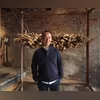
Born in Kathmandu in 1968, Sherpa trained under his father, Master Urgen Dorje, in traditional Tibetan thangka painting. His move to the United States, however, marked a turning point. “After moving to the US, my own experience of embracing a new culture made me aware of the shared experiences of the Himalayan diaspora,” he says. “In that transition, concrete beliefs of identity and worldview are reevaluated. The abstraction of traditional motifs in my work represents this transition — filled with both uncertainty and possibility.”
Children of Heaven 3, 2019 (Credit: AstaGuru)
His heritage itself embodies layered belonging. “I have inherited the Tibetan heritage from my grandmother’s side, while my father’s side is rooted in the native Himalayan community of Nepal,” he says. This dual identity informs his deep empathy for diasporic narratives and fuels the hybridity in his art. “Culture is inherently in a constant state of change,” he observes. “Moving between two distinct cultures, the contemporary Himalayan identity is remolded as a synthesis of the two – spirituality and materiality, community and individuality, the past and the present.”

 "Tsherin Sherpa's first solo show in India is a Himalayan dialogue")











