Investors may want to bottom fish in stocks of oil marketing companies

Macro conditions could improve and valuations are already low
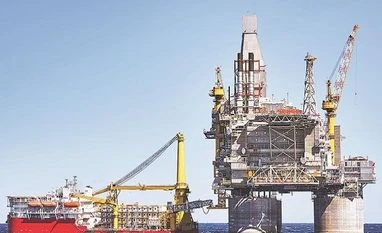
Oil, OMCs, Oil rig, Fuel, Indian Oil, Hindustan OIL, Bharat Petroleum, Petrol, Gas, LPG, Oil drilling, block, basin
Devangshu Datta
3 min read Last Updated : Aug 25 2023 | 11:29 PM IST
Margins for the oil refining and retailing sector have moved off their peaks, and the average integrated margins (refining plus marketing) for oil marketing companies (OMCs) have normalised. The ascent in crude oil prices, combined with static retail prices, has depressed marketing margins for diesel and petrol. However, the fall in marketing margins has been offset by increased gross refining margins (GRMs).

The current integrated margin is estimated at about Rs 7.4 per litre, which exceeds the average margins of Rs 5 per litre in the 2020-21 financial year (FY21) and Rs 4.5 per litre in FY22. The rise in crude prices is often linked to voluntary supply cuts from Saudi Arabia and Russia. However, oil prices are likely to soften as additional supply from non-OPEC (Organization of Petroleum Exporting Countries) nations emerges, and due to weak global demand, supply overhangs could transpire.

Commodity traders eyeing futures prices project that crude will linger in the $75-$85 per barrel range in the medium term, leading to a normalisation for OMCs’ integrated margins. The volume for OMCs had already normalised in the first quarter (Q1) of FY24.

During Q1FY24, crude prices averaged at $78 per barrel, while they have escalated to $85 in Q2. This has thrust gross marketing margins for diesel into the slightly negative territory, and petrol margins are barely in the positive.

However, GRMs have been extraordinarily strong because of seasonal factors and maintenance in Europe, resulting in some refining capacity shutdowns. The benchmark Singapore GRM currently stands at $14. Russian crude discounts favour Indian OMCs, but the discounts have declined from $10 levels to $5. Considering both marketing margin and GRM, the integrated margin for OMCs is higher than usual at Rs 7.4 per litre.

In liquefied petroleum gas (LPG), OMCs are thought to be recording healthy margins of around Rs 3 per kg, but a substantial proportion of surplus LPG margins (aggregated to an estimated Rs 12,000 crore) is suspended to cover any future under-recovery. This surplus might otherwise be applied to compensate for FY23 under-recoveries in petrol and diesel.

OMCs held a combined market share of 90 per cent in diesel and 91 per cent in petrol in FY22, when marketing margins were at standard levels. In FY23, private refiners lost more market share as marketing margins plunged deeply into the negative.

However, Q1FY24 was robust, with margins escalating to Rs 10 per litre, and private players enhancing market share to around 8-9 per cent. If marketing margins persist as net-negative as they currently stand, private market share is likely to wane again. Among the three OMCs, HPCL has recorded a net gain of 88 basis points (bps) and 123 bps in petrol and diesel, respectively, while BPCL had a 13 bps (petrol)/60 bps (diesel) gain, and IOCL had a 21 bps (petrol) gain/loss of 63 bps (diesel), respectively.
 
If crude remains within the $75-$85 per barrel range, OMCs may likely uphold net positive margins. The global GRM trend appears favourable, and Russian crude discounts are anticipated to persist.
 
The aggregate earnings before interest, tax, depreciation and amortisation (Ebitda) for OMCs was higher in Q1FY24, and volume growth is probable in Q2FY24 as the economy rallies.

Nevertheless, the market seems to be disheartened. Regardless of the outcomes, OMCs are expected to distribute substantial dividends owing to government policy. Stocks of OMCs have declined between 7 and 13 per cent in the previous month. Valuations are already depressed, and investors may perceive a buying opportunity if share prices continue to fall.


One subscription. Two world-class reads.

Already subscribed? Log in

Subscribe to read the full story →
*Subscribe to Business Standard digital and get complimentary access to The New York Times

Smart Quarterly

₹900

3 Months

₹300/Month

SAVE 25%

Smart Essential

₹2,700

1 Year

₹225/Month

SAVE 46%
*Complimentary New York Times access for the 2nd year will be given after 12 months

Super Saver

₹3,900

2 Years

₹162/Month

Subscribe

Renews automatically, cancel anytime

Here’s what’s included in our digital subscription plans

Exclusive premium stories online

  • Over 30 premium stories daily, handpicked by our editors

Complimentary Access to The New York Times

  • News, Games, Cooking, Audio, Wirecutter & The Athletic

Business Standard Epaper

  • Digital replica of our daily newspaper — with options to read, save, and share

Curated Newsletters

  • Insights on markets, finance, politics, tech, and more delivered to your inbox

Market Analysis & Investment Insights

  • In-depth market analysis & insights with access to The Smart Investor

Archives

  • Repository of articles and publications dating back to 1997

Ad-free Reading

  • Uninterrupted reading experience with no advertisements

Seamless Access Across All Devices

  • Access Business Standard across devices — mobile, tablet, or PC, via web or app

Topics :OMCsOMCs Indian OilCrude Oil Prices

Next Story


