Home / Politics / Lost all intellectual honesty: Congress' Jairam Ramesh slams EAM Jaishankar
Lost all intellectual honesty: Congress' Jairam Ramesh slams EAM Jaishankar
This response came after Jaishankar, in an exclusive interview with ANI, highlighted the first Prime Minister's decision to reject the US proposal to join the United Nations Security Council (UNSC)
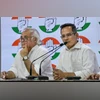
"He was expected to bend. He is now crawling. People with integrity are cringing. Very sad," he added in his post | (PTI Photo/Vijay Verma)
Senior Congress leader Jairam Ramesh criticised External Affairs Minister S. Jaishankar on Tuesday for his remarks on 'Nehru's China policy,' stating that Jaishankar has "lost all intellectual honesty and objectivity."
Taking to the social media platform X, the Congress General Secretary in charge of Communications claimed that the External Affairs Minister is a 'neo-convert' who indulges in Nehru-bashing to further ingratiate himself with the Prime Minister.
"Every time I read statements made by the erudite and dapper External Affairs Minister on Nehru, I can only recall the numerous parikramas he would make around Nehruvians for his plum postings. I can understand that he is a neo-convert who has to indulge in Nehru-bashing to ingratiate himself even more with the Prime Minister. But in doing so, he has lost all intellectual honesty and objectivity," Jairam Ramesh said.
"He was expected to bend. He is now crawling. People with integrity are cringing. Very sad," he added in his post.
This response came after Jaishankar, in an exclusive interview with ANI, highlighted the first Prime Minister's decision to reject the US proposal to join the United Nations Security Council (UNSC).
"Even when it came, for example, to the UN Security Council seat, it's not my case that we should have necessarily taken the seat; it's a different debate, but to say that we should first let China -- China's interest should come first, it's a very peculiar statement to make," Jaishankar said in the interview.
He said, "Early into Nehru's tenure, Sino-Indian relations were characterised by what was perceived as friendship and cordiality that covered both bilateral and regional and international issues; however, India got a rude awakening when China launched a war in 1962 that gave decision-makers in New Delhi a reality check on their China policy."
"It takes two hands to clap. I pose the issue in this manner if you look at the last 75 plus years of our foreign policy, they have a strain of realism about China and have a strain of idealism, romanticism, non-realism. It begins right from day one, there is a sharp difference of opinion -- how to respond to China between Nehru and Sardar Patel," said Jaishankar while responding to a question on whether the two nations will bury the hatchet in 2024.
The EAM also dwelt on the 'Chindia policy' and said, "The alternative strain, which starts from Nehru's China's first policy--first let China take seat, then we will see for India. From China's first policy, it ends up as Chindia policy."
"Chindia," an idea that projects the joint rise of China and India, was promoted by Congress leader Jairam, who called for constructive cooperation and competition between the Asian giants in 2014.
"You should ask the inventor of the term," said Jaishankar.
(Only the headline and picture of this report may have been reworked by the Business Standard staff; the rest of the content is auto-generated from a syndicated feed.)

 "Lost all intellectual honesty: Congress' Jairam Ramesh slams EAM Jaishankar")

