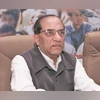
In his later years, veteran Bharatiya Janata Party (BJP) leader Vijay Kumar Malhotra, who passed away on Tuesday at 94, was better remembered as a sports administrator and the man who in the 1999 Lok Sabha elections defeated Manmohan Singh from the South Delhi constituency.
It was a crucial election for both. After five years in the Rajya Sabha, Malhotra was trying to get back to the House of the People. For Singh, it was his first foray into electoral politics, and the only one. Malhotra defeated Singh by 29,999 votes, and the BJP swept all of Delhi’s seven Lok Sabha seats.
In the 2004 Lok Sabha polls, Malhotra was the only BJP candidate to retain his Lok Sabha seat, with the Congress winning the remaining six. It proved to be the last Lok Sabha election that Malhotra, a stalwart of the BJP in Delhi, was to contest. In the 2008 Delhi Assembly polls, Malhotra was the BJP’s chief ministerial face against the incumbent, the Congress’ Sheila Dikshit. In polling that took place days after the 26/11 Mumbai terror attacks, the Congress retained Delhi. Malhotra quit his Lok Sabha seat to serve as the leader of the Opposition in the Delhi Assembly.
Malhotra served as senior lecturer and reader at Delhi University’s PGDAV College for 36 years. He was made acting president of the Indian Olympic Association (IOA) from April 26, 2011, to December 5, 2012 after Suresh Kalmadi was arrested in the 2010 Commonwealth Games corruption scandal. He was also Chef-de-Mission of the Indian contingent during the Tehran Asian Games in 1974. Over the years, Malhotra nurtured Indian archery. He was a founder of the Archery Association of India, and served as the national federation's president for more than 40 years, from 1973 to 2015.
On Monday evening, hours before Malhotra passed away, Prime Minister Narendra Modi inaugurated the new office of the BJP’s Delhi state unit where he recalled Malhotra’s contribution in making the Bharatiya Jana Sangh (BJS), the earlier avatar of the BJP, a force in Delhi politics.
Malhotra was born in Lahore on December 3, 1931, and his family shifted to Delhi during the partition, when he and his colleagues worked among the refugees, which became the core support of the BJS in later years. Malhotra was a member for two terms (1958-67) of the Municipal Corporation of Delhi. From 1967 to 72, he was chief executive councillor of the Delhi Administration, which was equivalent to a chief minister in protocol.
According to Malhotra’s Lok Sabha profile, he spent six months in jail in 1953 after being arrested, along with Syama Prasad Mookerjee and N C Chatterjee, as part of a protest to demand that Jammu & Kashmir become “an integral part of India”.
In 1966, Malhotra stated in his profile that he “narrowly escaped a bullet in police firing in the cow protection campaign” and was jailed for a fortnight. He spent 19 months in jail during the Emergency.
He won his first Lok Sabha election in 1977 from South Delhi, losing in 1980, and again in 1984 to Lalit Maken, and then to Arjun Singh in a bypoll in 1985 after Maken was killed by militants in July 1985. Malhotra won from the Delhi Sadar seat in 1989.
He was the BJS Delhi unit chief in the 1970s, also the Janata Party’s Delhi unit chief from 1977 to 1980, when the BJS had merged into it, and then of the BJP after it was founded in April 1980.
Along with Kedarnath Sahni and Madan Lal Khurana, Malhotra formed the core of the BJP’s Delhi unit leadership. However, from a Punjabi-dominated city, Delhi started becoming more diverse in the 1990s and 2000s, and the influence of the Punjabi political leadership, both in the BJP and also the Congress, also waned.

 "Obituary: Vijay Kumar Malhotra, Delhi BJP's last link with Partition")



