Gandhi's unknown love: Music wound its way around him in strangest of ways

Music wound its way around Gandhi in the strangest of ways. He once declared: 'There can be no swaraj where there is no harmony, no music'
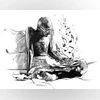
Mohandas Karamchand Gandhi
“You know I have no ear for Western music, and the result was a ludicrous failure,” Gandhi told Doke. “The violin was to cultivate the ear, it only cultivated disappointment.” Illustration: Binay Sinha.
Dipankar De Sarkar New Delhi
8 min read Last Updated : Oct 01 2025 | 11:10 PM IST

Don't want to miss the best from Business Standard?

Mohandas Karamchand Gandhi had a love few knew of — and that was for music. When hymns ring in the 156th birth anniversary of Gandhi on October 2, let’s recall how the famously frugal advocate of self-discipline was also a great music buff.
 
A careful examination of his comments and letters catalogued in the 90 volumes of The Collected Works of Mahatma Gandhi reveals a lifelong fan of music and musicians. Gandhi loved and used music to focus his own mind, and calm the minds of the public through the darkest days of the Indian freedom struggle. In this, he had another ally — the spinning wheel. 
An outstanding piece from Gandhi’s playlist found its way into the early editions of Beating Retreat ceremony in New Delhi — which historically signified the withdrawal of troops and the return of peace, and marks the culmination of the Republic Day celebrations showcasing India’s military might. The standout piece at the ceremony then was the Christian hymn, Abide With Me. It would be the last piece, played by the military band against the backdrop of a setting sun, bells chiming in the distance. 
The song was one of Gandhi’s favourites, although, having grown up in a Vaishnavite milieu in Gujarat (his father was the diwan of Porbandar and Rajkot), he came late to Christian hymns — at the age of 19, during his first visit to England, to study law.  Much later, Joseph Doke, a Baptist minister and Gandhi’s close associate in South Africa, would recount in MK Gandhi: An Indian Patriot in South Africa how Gandhi thought it necessary to take dancing, elocution, French, and violin lessons in London to become an “English gentleman”. 
“You know I have no ear for Western music, and the result was a ludicrous failure,” Gandhi told Doke. “The violin was to cultivate the ear, it only cultivated disappointment.” 
But music won the day. After clearing law, Gandhi returned to India and then headed out to South Africa in 1893 to work for an Indian law firm. This is where he came across racial discrimination. For the first time, perhaps, he turned to music in an hour of darkness. 
On the morning of February 10, 1908, Gandhi was assaulted by an Asian man outside the registration office in Johannesburg. Mir Alam was an opponent of Gandhi’s views on a South African registration scheme for “Asiatic” immigrants. But Gandhi wanted no charges brought against his assailant. The man did not know what he was doing, he argued. And he made another point: Hindus should not take offence from the fact that his assailant was a Muslim. “Rather let the blood spilt today cement the two communities indissolubly. Such is my heartfelt prayer.” 
Later that day, after he had been stitched up, he was taken to Doke’s home, where he was staying. Gandhi writes in Satyagraha in South Africa that he asked for Doke’s daughter, Olive, then a little girl, to sing for him the hymn Lead, Kindly Light. “…The melodious voice of little Olive reverberates in my ears.” 
When he returned to India for good in 1915, he visited Rabindranath Tagore’s Santiniketan, where he heard the beautiful early morning prayers that are a ritual in Tagore’s ashram-university to this day, and these melodies were to find a permanent home later in Gandhi’s multi-faith prayer book, Ashram Bhajanavali. 
Tagore and Gandhi’s lifelong friendship was cemented by music. When Gandhi was seriously unwell in Pune after a fast in 1932, Tagore rushed to him despite his own ill-health. Gandhi broke his fast with a glass of juice offered by Tagore. The poet then sang his meditative Bengali composition, Jibono jakhono shukaye jaay — “When the heart is parched, come upon me with a shower of mercy” — a song that Gandhi would reference many times in his prayer meetings. Another Tagore song that Gandhi often invoked, of course, was Ekla Chalo Re (If they answer not to thy call, walk alone). 
Musically, an important phase centred on the selection of prayers in Gandhi’s ashrams at Kochrab and Sabarmati in Gujarat, and Sevagram in Maharashtra. The peaceful life inside the ashrams appears today to have been in complete contrast to the violence raging outside, reflected in religious rioting and the brutality of the Raj. 
Outside, songs could divide: In the mid-1920s, Gandhi was confronted with Hindu-Muslim rioting over the issue of songs sung during prabhat pheris, or morning processions, when Muslims objected to Hindu demands to play music outside mosques. Gandhi’s compromise, according to the historian Lakshmi Subramanian in her book Singing Gandhi’s India, was to insist that Muslims submit to the demand against cow slaughter and Hindus maintain silence outside mosques. 
“Music pacifies anger,” Gandhi said in 1928. 
Inside his ashrams, discipline and prayer helped build a cohesive and structured life. One of the biggest influences here was the great Hindustani classical singer D V Paluskar, famous for his rendition of Ramdhun, the staple of ashram prayers. The lines Ishwar-Allah tero naam were introduced much later in the song, possibly in the 1940s. 
Another favourite was the doyenne of Carnatic music, M S Subbulakshmi — although Gandhi himself did not seem to have much time for the high arts. Subbulakshmi’s version of the Gujarati bhajan Vaishnava Jana To, strongly associated with Gandhi’s multi-faith message, is preserved on YouTube, and sparkles with matchless innovation. 
The Ashram Bhajanavali is an astounding book. It has some 200 prayers from all major religions, and in multiple languages. There are bhajans, Tagore songs, Christian hymns (described as Angreji Bhajan), verses from the Quran, Buddhist, and Judaic prayers, and Sikh and Zoroastrian religious verses. There are Sanskrit shlokas and verses, including from the Upanishads and the Mahabharata. One of the Islamic prayers in the Bhajanavali is Al-Fatiha, the opening chapter of the Quran. 
Writing in Young India in 1920, Gandhi said, “Our great stumbling block is that we have neglected music… Unfortunately, like our shastras, music has been a prerogative of the few.” 
In 1926, he went so far as to declare, “There can be no swaraj (independence) where there is no harmony, no music.”
 
Music wound its way around Gandhi in the strangest of ways. On November 26, 1920, at the start of the non-cooperation movement, Gandhi addressed a meeting at Benares’s Town Hall, attended by courtesans, including Vidyadhari Bai and Husna Bai. Under his sway, Husna Bai later formed the Tawaif Sabha of Kashi, which aimed to support the freedom movement and improve the lives of courtesans. Tawaif singers, ostracised by the world, joined Gandhi’s charkha movement. 
Things were darkening, falling apart, all around Gandhi in the 1940s. His prayer meetings invited the wrath of religious groups for their multi-faith songs. One incident stands out. 
The singer, poet, musicologist and Aurobindo disciple Dilip Kumar Roy visited Gandhi at Birla House in October 1947. Gandhi asked him to attend the evening prayer and sing Hum Aise Desh ke Wasi Hain, a song full of nationalistic imagery. 
At the meeting, a Sikh stalwart confronted Roy with some “fiery words” about the inclusion of Quranic verses in Gandhi’s prayers. “Calm yourself, my friend,” Roy said. And at the spur of the moment, Roy did the unthinkable, deciding not to sing the song Gandhi wanted. Instead, he sang Preet ka Geet, a song of love and Krishna, written by the poet Hafiz Jalandhari. 
After the meeting, Roy writes, “The old Sikh overtook me and made me his obeisance and thanked the Mahatma warmly. The Mahatma gave him a long look but it was a sad look he bestowed.” 
In three months, the father of the nation would be assassinated just before a prayer meeting. 
Did his insistence on multi-faith songs have anything to do with his violent death? His choice of songs was certainly the burning symbol of his belief in the equality of religions. 
Throughout his life in India, since at least 1917, Gandhi constantly referred to what he called the music of the spinning wheel. In 1930, when a Chinese friend asked him how it was possible to find peace of mind in such troubled times, Gandhi replied, “Take to spinning. The music of the spinning wheel will be as balm to your soul.” 
Music, his old love, and the charkha, the most visible symbol of Satyagraha — Gandhi held on to these anchors ever tighter as his hold over the nation itself loosened, singed by the flames of sectarianism. Gandhi was right: You can practically hear the repeated lines of Ramdhun in the meditative hum of the spinning wheel.

One subscription. Two world-class reads.

Already subscribed? Log in

Subscribe to read the full story →
*Subscribe to Business Standard digital and get complimentary access to The New York Times

Smart Quarterly

₹900

3 Months

₹300/Month

SAVE 25%

Smart Essential

₹2,700

1 Year

₹225/Month

SAVE 46%
*Complimentary New York Times access for the 2nd year will be given after 12 months

Super Saver

₹3,900

2 Years

₹162/Month

Subscribe

Renews automatically, cancel anytime

Here’s what’s included in our digital subscription plans

Exclusive premium stories online

  • Over 30 premium stories daily, handpicked by our editors

Complimentary Access to The New York Times

  • News, Games, Cooking, Audio, Wirecutter & The Athletic

Business Standard Epaper

  • Digital replica of our daily newspaper — with options to read, save, and share

Curated Newsletters

  • Insights on markets, finance, politics, tech, and more delivered to your inbox

Market Analysis & Investment Insights

  • In-depth market analysis & insights with access to The Smart Investor

Archives

  • Repository of articles and publications dating back to 1997

Ad-free Reading

  • Uninterrupted reading experience with no advertisements

Seamless Access Across All Devices

  • Access Business Standard across devices — mobile, tablet, or PC, via web or app

Topics :Mahatma GandhiMusic

Next Story


