A severe solar storm this weekend brought a dazzling display of the Northern Lights that could be seen across Europe and as far south as Alabama in the US, while threatening to trigger blackouts and disrupt navigation systems around the world.
An extreme geomagnetic storm is underway as energy from the sun collided with Earth’s magnetic field, the US Space Weather Prediction Center said. The threshold for the G5 storm, the highest on the center’s five-step scale, was reached at 6:54 pm New York time.
The last time a storm this strong struck Earth was in October 2003, which caused power outages in Sweden and damaged transformers in South Africa, said the agency, which is part of the US National Weather Service. The storms came about after five coronal mass ejections burst from a large sunspot cluster earlier this week.
Having so many of these bursts of energy spaced so close together is very rare, said Michael Wiltberger, a scientist at the National Center for Atmospheric Research. “Five is amazing. I am just stunned.”
Wiltberger said scientists weren’t sure what would happen with the coronal mass ejections coming so close together and how they would interact with each other and the Earth’s magnetic field. Where skies are clear, reports are coming in from all over the world from people seeing the aurora.
In addition to the brilliant cosmic display, a G5 storm can disrupt electric grids and satellites, energize pipelines and cause havoc with global navigation systems. SpaceX satellites are “feeling” the solar storm, Elon Musk said in a post on X without elaborating.
US Space Weather officials have been in contact with grid and pipeline operators so they are prepared, said Shawn Dahl, a US space weather forecaster. The danger is that the storms can inject direct current into alternating current transmission lines, as well as sending low pulses of electricity through things like railroad tracks and pipelines. Some GPS signals may be lost during the event.
The storm’s true power will be known when it is about 1 million miles (1.6 million kilometers) from Earth, where satellites are parked to act as warning beacons. Large parts of Asia, Europe and North America may be able to see an aurora, often called the Northern Lights, overnight where skies are dark and clear enough, the UK Met Office said earlier.
While the aurora may be only visible with the naked eye as far south as Alabama and California, mobile phone cameras can often pick up displays further south that people cannot see.
In addition, trans-polar flights between Europe, Asia and North America will likely be rerouted to avoid increased radiation exposure for passengers and crews.
The culprit is a sunspot cluster visible on the right side of the sun’s disc that is 16 times wider than Earth. The sun, which rolls through an 11-year cycle in which the number of spots waxes and wanes, is approaching the peak of the current one that began in December 2019.
The cluster has been spitting out coronal mass ejections, or clouds of plasma, about every six to 12 hours, with the last one blasting out at about 3 a.m. New York time, said Brent Gordon, chief of the space services branch of the Space Weather Prediction Center.
The effects of the solar storm may last through the weekend into next week.

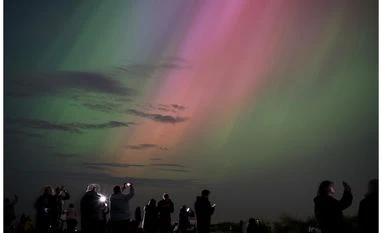 "Severe solar storm brings dazzling Aurora, threatens to trigger blackouts")

