The United States (US) has ordered a sweeping blockade on Venezuela’s oil trade, sharply escalating pressure on the government of President Nicolas Maduro and triggering fears that Washington may be laying the groundwork for another military conflict.
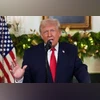
US President Donald Trump has ordered “a total and complete” blockade of all sanctioned oil tankers entering and leaving Venezuela, according to a Bloomberg report. The move comes amid a visible buildup of US naval forces in the region and warnings of possible land-based strikes.
Venezuela’s government has condemned the action as “warmongering threats”, the BBC reported.
Trump warns of unprecedented military pressure
Trump underlined the scale of the US military presence around Venezuela. “Venezuela is completely surrounded by the largest Armada ever assembled in the History of South America,” Trump wrote on Tuesday.
“It will only get bigger, and the shock to them will be like nothing they have ever seen before — Until such time as they return to the United States of America all of the Oil, Land, and other Assets that they previously stole from us.”
Trump also announced that Washington was designating the Maduro government as a “foreign terrorist organisation”. He accused what he described as the “illegitimate” regime of using oil revenues to fund crime.
According to Trump, Venezuela was “using oil from these stolen oil fields to finance themselves, drug terrorism, human trafficking, murder, and kidnapping".
Oil tanker seizure marks major escalation
The blockade follows the US seizure of an oil tanker off Venezuela’s coast last week, a move widely seen as a sharp escalation. For Venezuela, the impact is severe. Oil exports form the backbone of the country’s economy, and any disruption threatens government revenues, imports and basic supplies.
In recent weeks, US forces have also carried out deadly strikes on alleged Venezuelan drug-smuggling boats and significantly increased naval patrols in nearby waters.
Long history of oil disputes with Washington
Oil has long shaped US-Venezuela relations. American oil companies once dominated Venezuela’s petroleum industry until it was nationalised — first in the 1970s and later under Hugo Chavez and his successor, Maduro, Associated Press reported.
Washington has repeatedly challenged the compensation paid during these takeovers. In 2014, an international arbitration panel ordered Venezuela’s socialist government to pay $1.6 billion to ExxonMobil.
In recent years, however, US policy has shifted focus from commercial disputes to allegations that Maduro’s government is linked to drug trafficking networks. Trump has repeatedly claimed that oil revenues are being used to fund criminal activities.
Maduro prepares for possible conflict
In Caracas, President Maduro has urged Venezuelans to unite against what he calls US aggression and has asked citizens to join the country’s militia, which he claims has more than eight million members, Bloomberg reported.
His government has deployed troops, ships, aircraft and drones along the Colombian border, in coastal regions and on a strategically important island.
Earlier this week, Maduro described the US seizure of the oil tanker as “criminal and illegal”.
Against this backdrop, this blockade and military actions by the US could be a precursor to a war against Venezuela.
A familiar US playbook?
The situation has revived comparisons with past US interventions, where economic pressure, sanctions and control over energy resources preceded military action. As tensions rise between the two nations, fears are growing that the blockade may not remain an economic measure, but the opening act of a possible larger confrontation.
Vietnam: Escalation after containment
The US escalated its role in Vietnam to contain communism under the domino theory, fearing a North Vietnamese victory would spread communism across Southeast Asia after France withdrew in 1954. US involvement grew after the 1964 Gulf of Tonkin incident, when American ships reported attacks by North Vietnamese forces. The then-President Lyndon B Johnson launched heavy bombing campaigns and deployed ground troops, with US forces peaking at about 543,000 soldiers in 1969. The war involved intense guerrilla fighting, civilian casualties and the use of chemical agents like Agent Orange. Facing heavy losses and domestic opposition, the US withdrew in 1973, and South Vietnam fell two years later.
Iraq: Sanctions before invasion
US action against Iraq followed years of economic and military pressure before full-scale war. After Iraq invaded Kuwait in 1990, Washington led a global coalition that pushed Iraqi forces out. In the following years, the US imposed strict sanctions, enforced no-fly zones and carried out periodic air strikes, accusing Saddam Hussein of pursuing weapons of mass destruction. These measures weakened Iraq’s economy and military throughout the 1990s. In 2003, the US invaded Iraq, citing weapons of mass destruction (WMD) threats and links to terrorism after the 9/11 attacks. Saddam’s regime fell quickly, but no WMDs were found.
Libya: Intervention turns into regime change
The US intervened in Libya during the 2011 Arab Spring uprising against Muammar Gaddafi. As violence escalated, western governments said Gaddafi’s forces threatened civilians, prompting the UN to approve a no-fly zone under Resolution 1973. The US played a key role in launching air strikes and providing intelligence and logistics as part of Nato’s Operation Unified Protector. The intervention helped rebel forces overthrow Gaddafi, who was killed later that year. Critics argue the mission shifted from civilian protection to regime change. Libya has since faced political instability, armed conflict and economic collapse, with former US President Barack Obama later calling the intervention his “worst mistake”.

 "Oil, sanctions, and war. US blockade on Venezuela recalls past conflicts")


 Connect with us on WhatsApp