


Domestic jewellery demand takes a hit as gold scales Rs 90,000 per 10 grams
This is in tandem with international prices, which hit record highs and crossed $3,000 an ounce on Friday, say industry players. One ounce is approximately 28.35 gm
 "Gold, jewellery")
premium
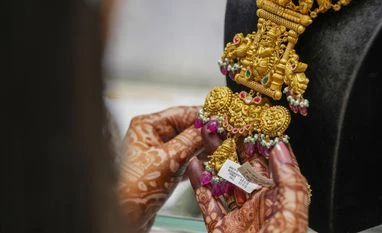
The trigger for international gold prices increasing to $3,000 per ounce was Germany’s upcoming heavy government borrowing. | (Photo: PTI)
5 min read Last Updated : Mar 17 2025 | 12:03 AM IST
Listen to This Article
Domestic demand for gold has taken a hit as the yellow metal traded at Rs 90,500-90,800 per 10 gm in Mumbai’s spot bullion market.
This is in tandem with international prices, which hit record highs and crossed $3,000 an ounce on Friday, say industry players. One ounce is approximately 28.35 gm.
The jewellery industry is toying with the question whether demand will return at these high prices as the marriage season has started, even as they are simultaneously preparing for changes in demand composition and considering tweaking products.
At the current high prices, gold is increasingly becoming unaffordable for the lower and middle class, the biggest buyers of gold in volumes, said Chirag Sheth, principal consultant of London-based bullion research firm Metal Focus.
According to a survey done in 2022 by the Indian Institute of Management Ahmedabad’s Indian Gold Policy Centre, unlike the general perception that only the rich buy gold, 56 per cent of gold was bought by people falling in the income group Rs 2-10 lakh. Since 2022, the price of gold has doubled but not the savings of these people and hence their capacity to buy more gold has reduced.
The trigger for international gold prices increasing to $3,000 per ounce was Germany’s upcoming heavy government borrowing. Traditionally, Germany has been one of the most fiscally responsible governments in the world and has avoided heavy borrowing. The confrontation between United States (US) President Donald Trump and Ukraine President Volodymyr Zelenskyy had an unintended consequence. Germany realised it had to spend heavily on defence because it could no longer reliably depend on the US.
Nigam Arora, a US-based algorithm analyst and an author of Arora Report, said: “Gold likes government borrowing as it is the antidote to weakening fiat currencies. However, in the short term, technically, gold is overbought. When gold gets overbought, it tends to pull back.”
Amid fears of the increase in the tariff on gold and silver, the US’ tariff policy has resulted in huge physical stocks of precious metals being sent to that country, adding fuel to the fire.
Given these developments, jewellers in the domestic market are preparing to address high prices.
Surendra Mehta, national secretary to the Indian Bullion and Jewellers Association (IBJA), said: “Marriage-related demand will be there but the shift towards low carat and lower weight jewellery will be seen.”
As of now, jewellery above 14-carat purity is being hallmarked. Low-carat jewellery, especially 18-carat, is preferred to diamond-studded jewellery.
Mehta said, “We have proposed to the government to permit hallmarking of 9-carat jewellery.”
While it takes time for low carat-lower purity jewellery to find traction, all these are efforts to survive in the business. Gold has traditionally remained in demand irrespective of price. Only buyers take time to realise that higher levels are sustaining.
An industry official, however, added that at the current high prices, there was a rush to sell old gold coins, bars and jewellery in exchange for cash. This, however, is a usual trend seen when gold prices rise.
“This time, the volume of sales is very high amidst inflationary trends and the need for cash. In the March quarter of 2023, old gold encashed for cash was 34.8 tonnes as per the World Gold Council (WGC) data. In the March 2024 quarter, it was 38.3 tonnes, and in the ongoing March quarter, it may cross that figure. The exchange of old jewellery for new is also rising and expected to reach half of the total sales very soon,” the official quoted earlier said.
So far as the gold price outlook is concerned, Arora said, “On the positive side, there are potential triggers that can cause gold to go even higher. The positive triggers include new tariffs, a lower dollar, lower interest rates, and increasing concerns about a potential recession in the US.
On the negative side, a cease-fire in the Ukraine will be negative for gold.” However, Arora added that, “The Arora Report’s long-term stance on gold remains bullish. Any significant dip will likely be a buying opportunity.” The US Federal Reserve’s FOMC is meeting on 18-19 March which may indicate further cuts in rates.
John Reade, Senior Market Strategist, Europe and Asia, WGC said, The recent rally has been the result of uncertainty around US tariffs and the developing trade war, which has been amplifying economic risks and market volatility, further driving investor interest in gold as a key diversifier.
“The big question now is whether gold can hold above $3,000. Heightened risk and uncertainty will certainly help sentiment, but this will need to be translated into stronger buying from investors, especially western buyers, or another step-up in central bank buying."·
- Yellow metal in overbought zone, but long-term trend still bullish
- Sale of old gold at peak prices to encash rally
- Jewellers eye low weight, lower carat jewellery sales as marriage season begins
- Industry proposes 9-carat jewellery to suit the low-income group