Looking back, Apple was not the first to launch a mobile phone. Brands such as Nokia, Motorola and Sony had beaten it to it. BlackBerry had the enterprise market in its vice-like grip, with even Barack Obama as US President swearing by it. Apple managed to upstage all its competitors who had believed that you needed to offer a keyboard on a mobile device. In fact, BlackBerry swore by its qwerty keyboard, and was unable to dump it even when the writing was on the wall. Nokia, too, did not respond fast enough as Apple changed the language of mobile phones by creating a new term: smartphone.
Apple’s secret — or not so secret — sauce was its App Store, which allowed third parties to develop and sell apps to Apple iPhone users. In the wake of this smartphone wave, brands like BlackBerry, Nokia, Sony, and even Motorola, faced rapid decline. It was left to Samsung to create exciting smartphones that used the Google-created Android platform.
Smartphones are everywhere today. India alone boasts over 650 smartphone users. If smartphones are ubiquitous, so are what is known in the trade as TWS – true wireless stereo – or simply put, earpods. When Apple ditched its headphone jack in 2016, I wondered if consumers would be ready to invest in a TWS. But that is what has happened. Not just with Apple, but also with all other smartphones. Today, every other person on Indian roads has a TWS sticking out of their ear. BoAt, an Indian brand, is now seen as a trendsetter and a global player in TWS devices.
Smartphones are today bought for not just making calls or sharing mails, but also as cameras, to the extent that several brands are sold for their better lenses etc. If you visit the famous Lalbaugcha Raja during the Ganapati festival in Mumbai, you can see almost everyone holding up their smartphones. Who is getting the darshan, the devotee or his/her smartphone, you wonder.
The same can be said of other memorable moments. Will you be watching your child blowing her two candles on her second birthday, or will you be hiding behind a smartphone?
All this may change if smart glasses take root and grow. Smart glasses can help you take calls, listen to music, click pictures and also shoot videos. It is possible that in the future, we can watch a celebrity wave to us and wave back, instead of hiding behind a smartphone! The same would apply to celebrations, weddings, birthdays, and more.
Will consumers be ready to adopt this innovation in large numbers? Smartphones have become ubiquitous. So have TWS. Smart watches, too, to an extent. Will the smart glasses innovation travel far?
It was Everett Rogers who proposed the theory of ‘Diffusion of Innovations’. Based on work done on pharmaceuticals and hybrid seeds, his theory, first published in 1962, proved that there are different classes of consumers when it comes adopting innovative products: the innovators (2.5 per cent), who will try anything new; the early adopters (13.5 per cent), who follow the innovators; the early majority (34 per cent); followed by the late majority (34 per cent); and finally, the laggards (16 per cent), who are still using feature phones in our smartphone story.
New products have to understand the dynamics and ensure they change their narrative as a product gains ground (do read my article on M S Swaminathan and the way he used diffusion of innovations theory to spread the hybrid seed movement in India; Business Standard, January 23, 2024, mybs.in/2dSp1Oe). Andy Grove, in his book Crossing the Chasm, proposed a corollary to Rogers’s theory. He said that many technology products quite easily find innovators to try the hot new device. They even get the early adopters. But if the marketer is not careful, the product could well fall into the chasm that divides the early adopters and the early majority. Unless the story is suitably adapted, the early majority may well dismiss the new product as a new toy for the geeks. Products like the original Segway, VR headsets, Google Glass, and Apple Newton have not been able to cross the chasm.
For smart glasses to get past the chasm, brands will have to do a lot more than just lower prices, though that will help. They will have to actively create use case scenarios. They will have to reach the early majority with new narratives that may be irrelevant to the innovators. If they manage to do that, we will be seeing smart glasses all around us, and we will not see people desperately reaching for their smartphones on every memorable occasion – or what used to be called the ‘Kodak Moment’.
The writer is a brand coach and bestselling author of 12 books. His latest book, Marketing Mixology, presents four essential skills for marketing success


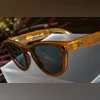 "Apple AI glasses")