


After Singur, a new chapter unfolds in Tata Group-West Bengal saga
A meeting between Chief Minister Mamata Banerjee and Tata Group Chairman N Chandrasekaran has rekindled hopes of fresh investments by the group in the state that goes to polls next year
 "N Chandrasekaran, Mamata Banerjee")
premium
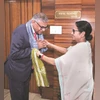
Tata Group Chairman Natarajan Chandrasekaran with West Bengal Chief Minister Mamata Banerjee
7 min read Last Updated : Jul 13 2025 | 11:13 PM IST
Listen to This Article
A picture is worth a thousand words, it is said. The frame capturing a beaming Tata Group Chairman Natarajan Chandrasekaran as West Bengal Chief Minister Mamata Banerjee greeted him with an uttariya (a traditional stole) at Nabanna, the state secretariat, was also rich in subtext.
The July 9 meeting marked the first formal engagement between a Tata Group Chairman and Banerjee, 14 years after she swept to power in 2011 on the back of a massive agitation against land acquisition that saw the dramatic exit of Tata Motors’ Nano project from Singur and reshaped the state’s political landscape.
After the meeting, Banerjee’s party, the Trinamool Congress (TMC), said that the chief minister hosted Chandrasekaran for a dialogue centred on West Bengal’s growth. “The meeting reflected the state’s commitment to fostering public-private partnerships that drive innovation, investment and inclusive development.” The party also said that the conversation focused on deepening the Tata group’s presence in the state.
A potential reset in the relationship with one of India’s biggest conglomerates — or the start of a new chapter — it’s a scene still unfolding.
But as a highly placed source in the government put it — the biggest takeaway is that the cloud of the Singur episode has lifted. “What emerges in the sunshine remains to be seen, but both sides seem eager to start afresh.” “It’s an open, objective business relationship with the state now,” the official added.
Chandra keeps his word
The moment has been in the making for some months now. The chief minister had invited Chandrasekaran for the Bengal Global Business Summit (BGBS) held in February. He could not make it. But a phone call on the eve of the investor summit broke the ice.
At the inaugural ceremony, Banerjee had said: “He (Chandrasekaran) has assured (me) that they want to invest more and more in Bengal. And he will come to Bengal very soon and discuss (things in detail).”
Chandrasekaran appears to have kept his word. Accompanied by the Confederation of Indian Industry (CII) Director General Chandrajit Banerjee — the meeting is said to have lasted about 45 minutes. West Bengal Chief Secretary Manoj Pant was also present.
A chequered past
What might have passed as a routine meeting between a business leader and a chief minister was anything but that — with a history of nearly two decades forming the backdrop.
The chronology of events goes like this. In 2006, the Left Front government had invoked the Land Acquisition Act of 1894 to acquire 997 acres in Singur for the Tata Motors’ Nano project. However, of the 13,000 project-affected farmers, 2,000 refused to accept compensation cheques. An indefinite agitation, backed by Banerjee who was then in the Opposition, followed for the return of land to the farmers. Finally, on October 3, 2008, Tata Motors decided to pull the plug on Singur. The plant was 80 per cent ready by then.
Within days, the project found a home at Sanand in Gujarat. Then at the helm, Ratan Tata had famously quipped: “I hope there is a bad M and a good M.”
In line with a Supreme Court order in 2016, the land in Singur was returned to those who lost it. Tata passed away last October. But an official in the West Bengal government pointed out that despite the history, Tata group companies have not only continued to operate in West Bengal, but expanded as well.
Business as usual
Perhaps, the biggest example of decentralisation in the Tata group is how the crown jewel of the group, Tata Consultancy Services (TCS) – India’s IT sector poster boy — expanded its footprint in Bengal.
According to government sources, TCS employs more than 54,000 in the state across multiple locations — the biggest campus is Gitanjali Park in New Town, Kolkata. The stage is now set for another campus spread across 20 acres at the Bengal Silicon Valley Hub, an upcoming tech centre. The Phase-I building plan for the campus recently got the New Town Development Authority (NKDA) nod. On completion of the second phase, the campus will have 2.4 million square feet of built-up space and create 25,000 direct employment opportunities, Banerjee had posted on X.
Tata Steel also has a sizeable presence in the state, employing more than 11,100 across strategic businesses like ductile iron pipes and bearings, Hooghly Met Coke, and a stainless steel plant at Bishnupur.
Also, West Bengal serves as a strategic logistics hub for Tata Steel, leveraging Haldia port for multi-modal shipments.
Tata Hitachi’s plant at Kharagpur — announced the same day as Nano — is among Asia’s biggest construction machinery manufacturing facilities. In 2019, the construction equipment manufacturer’s Jamshedpur operations also moved here. Tata Medical Center, inaugurated by Ratan Tata on May 16, 2011, is the go-to facility for cancer patients from the east and northeast. Yet, to take the working relationship to the next level, an ice-breaker was needed at the top, sources in the government conceded.
A turning point?
The meeting between the Tata Sons Chairman and the chief minister also serves as a signal to other investors — that the state is poised to go places, a government official noted.
According to the President of Indian Chamber of Commerce Abhyuday Jindal, the meeting between Mamata and Chandrasekaran underscores the state’s unwavering commitment to nurturing transformative public-private partnerships. “At the Indian Chamber of Commerce, we view this dialogue as a catalyst for innovation and inclusive growth. Such engagement lays the foundation for a more resilient and future-ready industrial ecosystem across Bengal for an Atmanirbhar Bharat.”
Director General of the Bengal Chamber of Commerce and Industry Subhodip Ghosh said that the meeting sends out a “positive vibe”.
“The ecosystem in West Bengal has vastly improved over the past few years. It’s the perception that is also changing now as this meeting sends out a strong message to the investor community at large.”
“The CM has decided to host a business and industry conclave after the Durga puja. It will focus on areas such as growth potential, employment intensity, export prospects, the state’s natural advantage and revenue generation,” says Amit Mitra, principal chief advisor to the CM. “The conclave will endeavour to discuss ways to take these aspects forward. Some other areas may be added after discussions with stakeholders,” he explained.
The state goes to election next year and the BGBS — on a much bigger scale — is likely to take place once the new government settles down.
For now, the meeting between Chandrasekaran and Mamata has rekindled expectations of fresh investments. The mood has shifted and hope is building up — is a new chapter waiting to be scripted in the Tata-Bengal saga?
Tata group in Bengal
TCS: Employs more than 54,000 across multiple locations; another campus spread across 20 acres is set to come up at the
Bengal Silicon Valley Hub
Tata Steel: Diversified presence with more than 11,100 employees
Tata Hitachi: JV between Japan’s Hitachi Construction Machinery Company and Tata Motors; has a plant at Kharagpur
Indian Hotels Company: Multiple properties across the state