


Govt making 100-day plan for new term, could rejig role of ministries
The current Lok Sabha's term ends on June 16, 2024, so elections have to be completed before that.
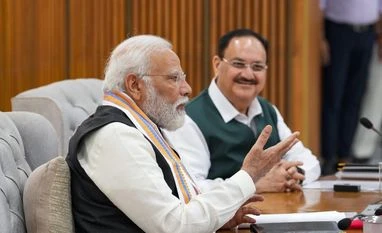 "PM Modi")
premium
PM Modi and BJP National President JP Nadda | (PTI Photo/Kamal Kishore)
6 min read Last Updated : Mar 12 2024 | 3:05 PM IST
The government is making a 100-day plan that could rejig ministries, confident that it will return to power in elections whose dates are yet to be announced. It is the third time since 2009 that such a plan is being made and the first to be conceptualised so early.
Prime Minister Narendra Modi has tasked the secretaries of all ministries and departments to prepare the plan, much before the new government is sworn in. The current Lok Sabha’s term ends on June 16, 2024, so elections have to be completed before that.
Modi took ownership of the agenda in each key aspect of these plans, often cutting across political executives. Within days of his government assuming office for the second term in 2019, its 100-day plan was rolled out. Modi included in the plan 167 “transformative ideas” for implementation. P K Sinha, who was the cabinet secretary then, monitored progress by scheduling a meeting every Friday. Ministries were asked to put up performance-monitoring dashboards, so the public could have a window to their progress.
Departments made presentations to new ministers and more often to the Prime Minister’s Office.
‘Political will’ needed
The agenda was more modest in 2009, when Manmohan Singh rolled out the first such plan as Prime Minister of the Congress-led United Progressive Alliance (UPA) government. While the Congress party took time to distribute ministries, government secretaries began work on the plan. In line with the UPA government’s style of functioning, a panel of independent experts got the same billing as government department secretaries to prepare the plan, which was then approved by the cabinet.
The Modi government has asked ministries to involve experts and hold discussions with the agencies under their control to firm up the plan. A source in the government said key departments began preparations almost immediately after the budget session of the Parliament ended.
Modi held an eight-hour meeting in Delhi last week during which departments made presentations and got feedback from others about their projects.
Former finance secretary Ashok Chawla said the eventual performance of the 100 day agenda depends on the “political will and determination of the political executive of the day”.
The 100-day plan will be part of a larger agenda of the new government, it is understood. In essence it will have short-term projects which can be visibly fulfilled, so departments have largely stayed away from suggesting committee formats to examine various issues.
One issue being worked on over is a change in the number of ministries and their role. There are various possibilities, said a top source in the government. This has been considered at the level of the Prime Minister’s Office and the cabinet secretariat. The intention is to also take the new framework to the level of state governments. The 100-day plan will include these changes so that the public can see a visible change in the government’s functioning, said the source. (What change?)
Governance reform
At the level of ministries, project ideas are based on a four-fold framework of economic growth, environmental sustainability, social progress, and governance. Chawla said without political backing 100-day plans become like New Year resolutions “which are put on the back-burner or forgotten once the immediate priorities take over”.
The Finance Ministry has suggested reforming the Budget to bring in the scope for multi-year targets. This is necessary as capital budgets are difficult to complete year wise, said a government source. The plan is to change the structure of the budget and have provisions for expenditure for more than a year. This will be a huge change in government finance and is slated as a major priority.
Other measures being considered include expanding the Startup India programme to small towns and rural areas. The plan is to dovetail the central government’s targets with those of states, including steps to make clearances by various government bodies easier. However, as there shall be a Budget soon after the government comes to power, the suggestions have not dwelt on the specific tax breaks.
The Finance Ministry has proposed measures to widen the direct tax net. Like the Jan Dhan programme, which saw a record number of bank accounts being opened, the Finance Ministry would like the process of tax payment to become a widespread habit. It has already had some success here and plans to build upon those so that in a few years there is a massive scale up in the numbers of direct tax payers.
Civil service reform is also a key part of the agenda. The department of personnel and training has favoured setting yardsticks for the performance of civil servants. This is tricky: The civil service will be the means for implementing the 100-day agenda and the larger Visit Bharat @2047 programme, shifting them around could be difficult beyond a point. The department of personnel and training has flagged good governance as a major milestone with a lot of emphasis on Mission Karmayogi to roll out new courses to train civil servants which will be developed fast as new challenges emerge. So courses on AI and how to use tools like ChatGPT for answering queries, are on the cards.
Three ministries – rural development, women and child development ministry and health – have suggested improving the financial capacity of rural women. This will include reimagining the design of collectives like self help groups so that women decide on the agenda and then setting up a new financing mechanism to help them setting up all sorts of skill development centres and other mediums to allow for a faster turnaround in the job market.
In the infrastructure sector, the changes envisaged are faster flow of finance and clearances for projects. The GatiShakti umbrella is expected to get a stronger role. The inter secretarial body is expected to assume a formal role, dispensing with the need for the ministries like roads, railways and others to obtain approvals for projects, where they reach out to others with emails and meetings. This will ensure the faster utilisation of the fat capital budgets which are of late being approved by Parliament.
Topics : Lok Sabha elections BJP Modi govt