


Nitish govt bets on youth commission, women's quota to tackle migration
Two Cabinet decisions - 35 per cent reservation for permanent resident women in state government jobs, and the formation of the Bihar Youth Commission - have been rolled out with a promise
 "Bihar Youth")
premium
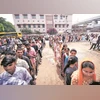
Candidates wait in queue for the Bihar police constable exam on Sunday. (Photo: PTI)
7 min read Last Updated : Jul 27 2025 | 11:37 PM IST
Listen to This Article
For decades, Bihar has carried the heavy tag of being a “one-way traffic state”, reflecting the persistent outflow of its workforce, particularly the skilled and the young. From Delhi’s crowded lanes to Punjab’s farms and Maharashtra’s construction sites, Bihari hands have built modern India, often far from home. But recent signals from the Nitish Kumar government suggest a desire to turn that tide.
Two Cabinet decisions — 35 per cent reservation for permanent resident women in state government jobs, and the formation of the Bihar Youth Commission — have been rolled out with a promise: To bring opportunity closer to home. Supporters hail these decisions as potentially game-changers, but sceptics remain unconvinced. “I don’t think these decisions will truly turn a new leaf in the ‘migration’ story that has been Bihar's identity for decades, and it has never been a core issue in the election,” says Naval Kishore Chaudhary, a retired professor and economist. His concern cuts deeper: “We need to foster a culture where young people aspire to be entrepreneurs, not just seek clerical jobs. Until Bihar embraces risk-taking and innovation like other regions, it will continue to bleed its talent.”
The migratory flow
Historically, migration from Bihar meant journeys to north-western states like Punjab and Haryana for agricultural work. In more recent decades, that flow has reoriented itself toward industrial and urban centres — Delhi NCR, Maharashtra, and Gujarat — where migrants have taken up low-skilled jobs in construction, manufacturing and agriculture. The numbers remain staggering.
The 2011 Census placed the total number of migrants in Bihar at 27.2 million, up from 20.5 million a decade earlier. A 2018 study by the International Growth Centre estimated the out-migration rate had risen to 15 per cent, three percentage points up from 2011.
Pinak Sarkar, in his analysis of 2011 Census data titled Out-Migration from Bihar: Major Reasons and Destinations, lists the primary interstate destinations as Delhi (19.34 per cent), Jharkhand (14.12 per cent), West Bengal (13.65 per cent), Maharashtra (10.55 per cent), Uttar Pradesh (10.24 per cent), and Haryana (7.06 per cent).
But migration isn’t solely an economic story. “We found that the highest migration is from Bihar’s northeast, while minimum migration is from Bhojpur district,” says Pyare Lal, director of the Bihar Institute of Economic Studies. In Bhojpur, the double-cropping system provides more local work, unlike others with a single crop a year. Women, too, feature heavily in migration data, primarily for marriage.
Government’s response
“Migration is not only a Bihar problem; it’s an eastern India problem,” says Bihar’s Industry Minister Nitish Mishra. But he’s quick to defend the state’s response, highlighting an industrial policy in place since 2016. “We’re building an ecosystem where enterprises can take root and grow, offering sustainable local options rather than just temporary fixes.”
But it’s not just about building factories, he insists. “The availability of good schools, hospitals, and electricity makes it possible for industry to thrive and for people to remain.”
The 2024 Bihar Business Connect summit pledged investments worth ₹1.80 trillion, with ₹82,584 crore already “grounded”, according to Mishra. On paper, at least, it’s a solid start.
Beyond industrial strategy, the government has leaned on rural employment schemes to curb “distress migration”. During the Covid pandemic, MGNREGS (Mahatma Gandhi National Rural Employment Guarantee Scheme) provided critical relief with 3.95 million new job applications filed between April 1 and May 20, 2022. Other schemes — Deendayal Antyodaya Yojana-National Rural Livelihoods Mission, Pradhan Mantri Awaas Yojana-Gramin, and Pradhan Mantri Gram Sadak Yojana — have also helped shore up rural economic activity.
The migration story is nuanced. Santosh Kumar Singh, minister of the labour resource department, distinguishes “migration” for betterment from “palayan (exodus).” “The latter signifies a desperate flight borne of fear, a scenario that defined Bihar’s past. Migration is for betterment — on which we are focussing now.”
Singh points to significant strides after 2008 but admits that a massive chunk of the labour force is unskilled. “Our mission is to ensure every village has a skilled centre and every villager has the opportunity to upskill themselves. With 60 per cent of Bihar’s population under 40, the task is daunting.”
Under the Bihar Building & Other Construction Workers scheme, 3.4 million construction workers are registered, and a dedicated migrant worker portal has registered another 650,000. Singh aims to increase the state’s organised sector workforce; there are currently 411,000 ESIC (Employees’ State Insurance Corporation)-insured workers.
Pressure points
The broader picture remains grim. Bihar, with a projected population of 127 million in 2023, accounted for 9.1 per cent of India’s population. It’s young, fast-growing, and significantly underemployed.
Economically, the state is a laggard. From 2012–13 to 2021–22, Bihar’s real Gross State Domestic Product (GSDP) grew at 5.0 per cent, below the national GDP average growth rate of 5.6 per cent. Its contribution to India’s nominal GDP has shrunk, from 3.6 per cent in 1990–91 to just 2.8 per cent in 2021–22. Nominal per capita income in 2021–22 stood at just 30 per cent of the national average.
In the labour market, too, challenges are abound. Bihar’s labour force participation rate hovered around 40 per cent, compared to a national average of 56 per cent (Periodic Labour Force Survey 2022-23). A July 2024 PIB release based on PLFS data showed the state’s overall unemployment rate at 3.9 per cent, higher than 3.2 per cent nationally. Youth unemployment in urban Bihar was at 10.8 per cent.
According to NITI Aayog’s report, Macro and Fiscal Landscape of the State of Bihar, as of 2022-23, nearly half the state’s working population (49.6 per cent) remained trapped in agriculture, forestry, and fishing. Services absorbed 28.9 per cent, construction 18.4 per cent, while just 5.7 per cent was employed in manufacturing. Bihar’s Multidimensional Poverty Index, too, was among the highest in the country at 36.95 per cent in 2022 (national average: 21.9 per cent).
Forward approach
There is no silver bullet. D M Divakar, former director, A N Sinha Institute of Social Sciences in Patna, reflects on missed opportunities: “The failure to profile returning migrant workers during the pandemic was a missed opportunity. Had we recorded their skills and created decentralised industrial planning, we could have joined this talent and curbed future migration waves.”
A fresh National Sample Survey (NSS) sample survey from January 2025 promises vital district-level data to shape more targeted responses.
But for ex-professor Chaudhary, the bigger challenge is cultural. “Talk to a typical Gujarati boy. After passing 10th grade, they’ll talk about business and industry. And here, they’ll line up for a peon’s job.”
The challenge, then, is not just economic. It is emotional, aspirational, and generational. As Divakar puts it: “Addressing Bihar’s complex migration challenge demands a sustained, multi-faceted approach — implementation of industrial policy, aggressive skill development, and a supportive ecosystem. Only then can Bihar truly harness its demographic dividend.”
Bihar’s economic pulse
Industrialisation: “Red” category
* Share in national industrial GSVA: 0.7% (least among 28 states)
* Industry share in state GVA (FY23): 20%
* Industrial components (mining, manufacturing, electricity, construction GVA): At least 25% lower than the national average.
Services: High share, low productivity
- Contribution to state GVA (FY23): 70%
* Low service intensity & low per capita service GSVA
Employment: Below national averages
- Worker-population ratio (all ages): Below national average of 43.7%
- Labour Force Participation Rate (all ages): Below national average of 45.1%
Regulatory environment: “Reform potential”
* Key labour law reforms:
- Fixed-term employment now notified
- Contract Labour Act threshold increased (from 20 to 50 workers)
Agricultural Sustainability Index
* Below the national average.
Source: Economic Survey 2025, NITI Aayog, State Economic Surveys, Annual PLFS Reports
Topics : Nitish Kumar Migration Bihar youth Bihar government